
Carbide Drill Improves Productivity For Heat Exchanger Manufacturer
After using this solid carbide drill, the company experienced a 250 percent increase in feed rates and a 250 percent jump in speed.
Share


Phillips Corporation - Education
Featured Content
View More

Phillips Corporation
Featured Content
View More

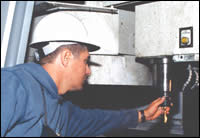
Wes Paskorz, a Cemline machine operator, examines a Dynapoint SE211HP solid carbide drill on a vertical machining center.
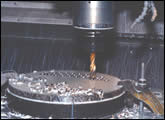
Since mid 2003, Cemline has been using the Dynapoint SE211HP solid carbide drill in grade KC7515 to improve feed rates and maximize time in the cut.
When companies invest in new production equipment, using the hole-making systems that worked well with their previous machinery often produces results that fall short of expectations. Cemline Corporation (Cheswick, Pennsylvania), a manufacturer of heat exchangers for commercial and industrial hydronic heating systems, experienced this problem. After the company purchased a CNC vertical machining center in late 2002 to increase productivity and improve the hole quality of its heat exchanger covers, the production team realized that maximum feed rates—which are essential in optimizing cost savings and increasing throughput—could not be achieved with the tooling used on the original machining center.
To reach its goal, the 50-person production team began exploring alternative drills for applications on stainless steel, brass and pre-machined plate steel heat exchanger covers. The tube sheets, which anchor the heat exchangers’ copper tube bundles, range in diameter from 4 inches to 24 inches and are 1 to 3 inches thick.


By the second quarter of 2003, within 6 months of activating the vertical machining center, the company began to use Dynapoint SE211HP solid carbide drills in grade KC7515 from Kennametal (Latrobe, Pennsylvania).
“The improved feed rates and tool life that we have experienced since making the switch are truly amazing, and the process of changing over to new tooling was much smoother than I thought it would be,” says Lindsay Chappell, Cemline’s owner and president.
The new solid carbide drill has allowed the company to experience a 250 percent increase in feed rates (from 2 ipm to 5 ipm), and a 250 percent jump in speed (from 1,000 rpm to 2,500 rpm).
The modular drill the company used prior to Dynapoint drilled only 200 to 300 holes, or 800 linear inches, before the carbide drill point needed to be replaced. The company can now drill 800 to 1,000 holes, or 2,400 linear inches, with one drill, maximizing time in the cut.
John Weinbrenner, Kennametal standard products engineer, recommended that Cemline develop and use an aluminum support plate on the underside of the exchanger cover to prevent flexing and damp vibration caused by the increased speeds and feeds of the SE211HP. The increased cover rigidity allowed Cemline to make holes in one pass.
The net result is that the company has reduced manufacturing time by 70 to 80 percent.
The productivity improvements that Dynapoint initiated have increased the company’s response time when fulfilling orders for replacement tube bundles, and the 57 percent cost-per-part reduction, from $61.08 to $26.02, has strengthened the company’s competitive edge.
The company also uses the manufacturer’s Blue Box Program, which reconditions drills. Using this program, Cemline sends its spent Dynapoint drills to the reconditioning service, where each drill is restored to factory standards by using the same kind of CNC grinding equipment on which the drills were originally manufactured.
“The Blue Box Program helps us get the most value for our hole-making dollars,” says Jason Chappell, Cemline’s production manager. “Before switching to Kennametal, we were unable to use re-ground drills for hole making in stainless steel and other tough-to-machine materials because those drills lacked the necessary consistency for manufacturing products that met customers’ specifications.”


Related Content

When ‘U’ Want to Turn on a Mill
A U-axis head can be a good option for shops hoping to perform turning and boring operations on a CNC milling machine.
Read More
Picking the Right End Mill
Kennametal global product manager Katie Myers explains how cutting tool features can impact machining strategies for different materials.
Read More
Finding the Right Tools for a Turning Shop
Xcelicut is a startup shop that has grown thanks to the right machines, cutting tools, grants and other resources.
Read More
Understanding Process Damping in Milling Operations
Despite the advances in modeling machining operations over the past decades, process damping remains a topic of interest, including new tool designs that increase the effect.
Read MoreRead Next

WEBINAR: From Machine Data to Guided Action: How Modern Shops Are Closing the Execution Gap
In this webinar, MachineMetrics Product Manager Josh Fish is joined by Pindel Global Precision's Thomas Deslongchamps, for a candid look at what closing the execution gap actually looks like inside a precision machining shop.
Read More