
Leveraging Laser Technology
Bruce Boone says laser technology enables him to make specialized rings from titanium and other materials that his competitors can’t offer.


Share


Phillips Corporation
Featured Content
View More


Phillips Corporation - Education
Featured Content
View More

Bruce Boone, owner of Boone Titanium Rings, says laser technology enables him to make specialized rings from titanium and other materials that his competitors can’t offer. He starts using a Mazak lathe to cut the ring blanks. Depending on the design, some ring blanks are then machined on a 4th axis machining center or tabletop mill. Most all of them require a great deal of hand finishing to complete.
However, using lasers to perform cutting and engraving operations has opened up greater design possibilities to create rings that others don’t offer. Bruce explains he had looked for a cutting laser for years, but couldn’t find just what he wanted: the power to cut through 7 mm of titanium yet deliver an extremely fine kerf. He also wanted the capability to perform both rotary and flat cutting. Machines with that much power are generally geared toward sheet metal work, and take up huge amounts of space while consuming huge amounts of power, he notes. This was not an option given his limited available shop floor space. Other lasers designed for stent cutting generate an extremely fine kerf, but don’t have the high power.


So he ended up building his own laser from a 4500-watt, quasi-continuous-mode IPG fiber engine and a Tormach machine. It has 450 watts of continuous power and can be pulsed to 4500 watts. Its 50-micron beam is capable of cutting through about 8mm of titanium.
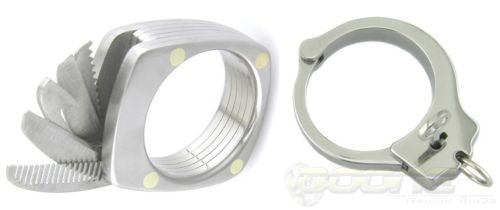
Here are a couple examples of rings made on this laser:
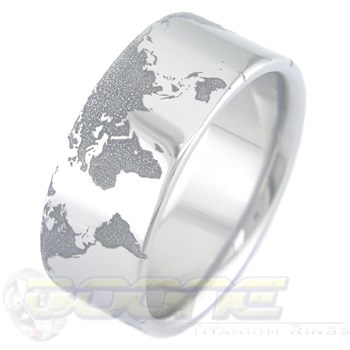
In addition to the fiber cutting laser, he also now has a CO2 laser, a welding YAG laser and an engraving YAG laser. The 80-watt engraving laser has a 19-micron kerf, which enables Bruce to produce detailed designs. This laser is four times more powerful than other jewelers that are starting to use lasers, he notes, so he can create much deeper engraved designs such as this:
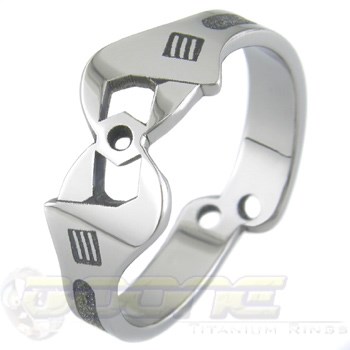
The possibilities grow when he combines cutting and engraving:
He has a number of cool designs on his website that are worth checking out, too. Thanks, Bruce, for sharing a bit about your process.
Related Content
-
A History of Precision: The Invention and Evolution of Swiss-Style Machining
In the late 1800s, a new technology — Swiss-type machines — emerged to serve Switzerland’s growing watchmaking industry. Today, Swiss-machined parts are ubiquitous, and there’s a good reason for that: No other machining technology can produce tiny, complex components more efficiently or at higher quality.
-
10 Robotic Solutions You Can Find at IMTS 2026
Discover how today’s robots and cobots are making it easier than ever to automate tasks, free up skilled workers, and run machines unattended – even in small and midsized shops.
-
Inside a CNC-Machined Gothic Monastery in Wyoming
An inside look into the Carmelite Monks of Wyoming, who are combining centuries-old Gothic architectural principles with modern CNC machining to build a monastery in the mountains of Wyoming.


_ROS-Display_TAP-Deep-Hole-300x250.jpg;maxWidth=300;quality=90;format=webp)

