Turning Centers Yield Solutions With Support
When this process engineer went searching for new turning centers for the Black&Decker plant in Fayetteville, North Carolina, he knew that he needed reliable machines, but he did not have a specific vendor in mind.
Share


Phillips Corporation
Featured Content
View More


Phillips Corporation - Education
Featured Content
View More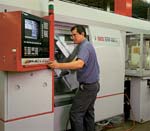
An employee at Black & Decker uses the Siemens control on the company's new Turn 465 turning center that machines parts for corded professional and household power tools.
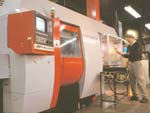
Black & Decker's new Turn 365 machine comes equipped with a robot called the "Gantry-Loader," which automatically loads and unloads the machine and places the finished part on the gage.
When Gary Smith went searching for new turning centers for the Black & Decker plant in Fayetteville, North Carolina, he knew that he needed reliable machines, but he did not have a specific vendor in mind. Black & Decker employees at the plant make corded professional and household power tools. There is constant motion with numerous assembly lines making all sorts of products simultaneously. Circular saws, table saws, miter saws and drills are just some of the tools made by the 1,600 workers during three shifts.
Mr. Smith, a process improvement engineer, is very meticulous and used a specific methodology in his search for a new vendor. Each prospect was given blanks and asked to turn them based on parameters provided by Mr. Smith. It was this capability study that formed a large part of Mr. Smith's evaluation.


Emco Maier (Columbus, Ohio) responded with two machines—the Turn 465, which produces the blank, and the Turn 365, which finishes the bore. "They by far had the best capability study," Mr. Smith says of Emco. The specified tolerance in the bore was ±0.0002 inch with a Cpk greater than 1.33. During the 2-hour continuous runoff, results were stored and evaluated. Emco's ET 365 beat the tolerance with an impressive Cpk value of 1.77.
"Gary's big complaint was that the machines he currently had weren't heavy duty enough and weren't going to last for the long-term like they wanted," says Jeff Murray, Emco Maier's director of marketing. "That's when we started looking at the 365 and the 465, two of our larger machines. They have the accuracy and longevity to run parts for them for a long time, so that's why we selected those two machines."
The Turn 465 features dual turrets and dual spindles. This enables it to cut cycle time in half on some parts because the front half of the part and the back half of the part are machined at the same time.
The Turn 365 comes equipped with a robot called the "Gantry Loader" that automatically loads and unloads the machine and places the finished part on the gage. The gage checks the part after it has been machined. If the part is in tolerance, it will go into a good chute. If the part is out of tolerance, the gage will note that and put the part on another slide to go to a different area. If the part is in tolerance but in the ‘danger zone,' it will be put in the good bin, but an automatic adjustment would be made on the machine so that the next part would be in the range.
Emco had the machines Mr. Smith wanted. But he also wanted something else: customer service. "Even if Emco had the best machine in the world, if they weren't going to be there to support and service the machine long-term, I don't want it," Mr. Smith says.
Viewing the process from afar, sales engineer Steve Price says, "Emco's responsiveness from the outset of their dealings with Black & Decker was above ordinary. They did a very good job of detail follow-through. Gary is a very meticulous guy, and Emco matched up with him. They fit."
The result was an order for a Turn 365 and Turn 465 from Emco Maier. It was a nearly 2-year quest that resulted in the machines arriving at the Black & Decker plant in July 2000. As part of the deal, Emco Maier committed to a week of installation and a week of training for each machine. "They spent a significant amount of time down here working with our people," Mr. Smith says.
And it has proven to be a good investment. Mr. Smith says he has been pleased with the machine's performance. "There's a little bit of a learning curve," he says, "because the Siemens controller is different than we're used to, but as far as the machines, everyone is very happy with them.
"I am very pleased with what they've done. I'm somewhat demanding. We pay a lot of money for this equipment, and a lot of vendors don't do their work. We buy turn-key operations. We don't buy a machine and install it ourselves. We don't have the resources. We buy the whole package from a vendor, and Emco has done some of the best work I've seen."


_ROS-Display_Made-For-This-300x250_Final.jpg;maxWidth=300;quality=90;format=webp)


Related Content

Where Manual Turning is as Valuable as CNC: Top Shops 2025
This year’s Top Shops Honoree in Machining Technology recently invested in both a flexible manufacturing system and a new manual turning machine. But why? Discover how both fit the shop’s success strategy in this article.
Read More
Maximizing Milling Operations With the Right Cutter
Selecting milling cutters that are suited to the task at hand can reduce cycle times, improve part quality and save money. Here’s where three milling cutters excel.
Read More
Multitasking Machines Scale Up Setup
Job shops don’t mass produce parts — they mass produce setups. Here’s how Sanks Machining has streamlined setup in its shop.
Read More
Why Setups Are the Real Bottleneck in High-Mix Machining
In job shops, throughput often lives in the steps between cuts: tooling, offsets, refixturing, programming and training. The March issue features practical ways shops are cutting setup time and variation through multitasking, modular tooling, process stability and more.
Read MoreRead Next

WEBINAR: From Machine Data to Guided Action: How Modern Shops Are Closing the Execution Gap
In this webinar, MachineMetrics Product Manager Josh Fish is joined by Pindel Global Precision's Thomas Deslongchamps, for a candid look at what closing the execution gap actually looks like inside a precision machining shop.
Read More

