
Tooling Line Enables Trepanning on a Mill
IMTS 2018: Thinbit’s Mill A Groove line of toolholders and inserts consolidate operations and provide quality finish for sealing surfaces.
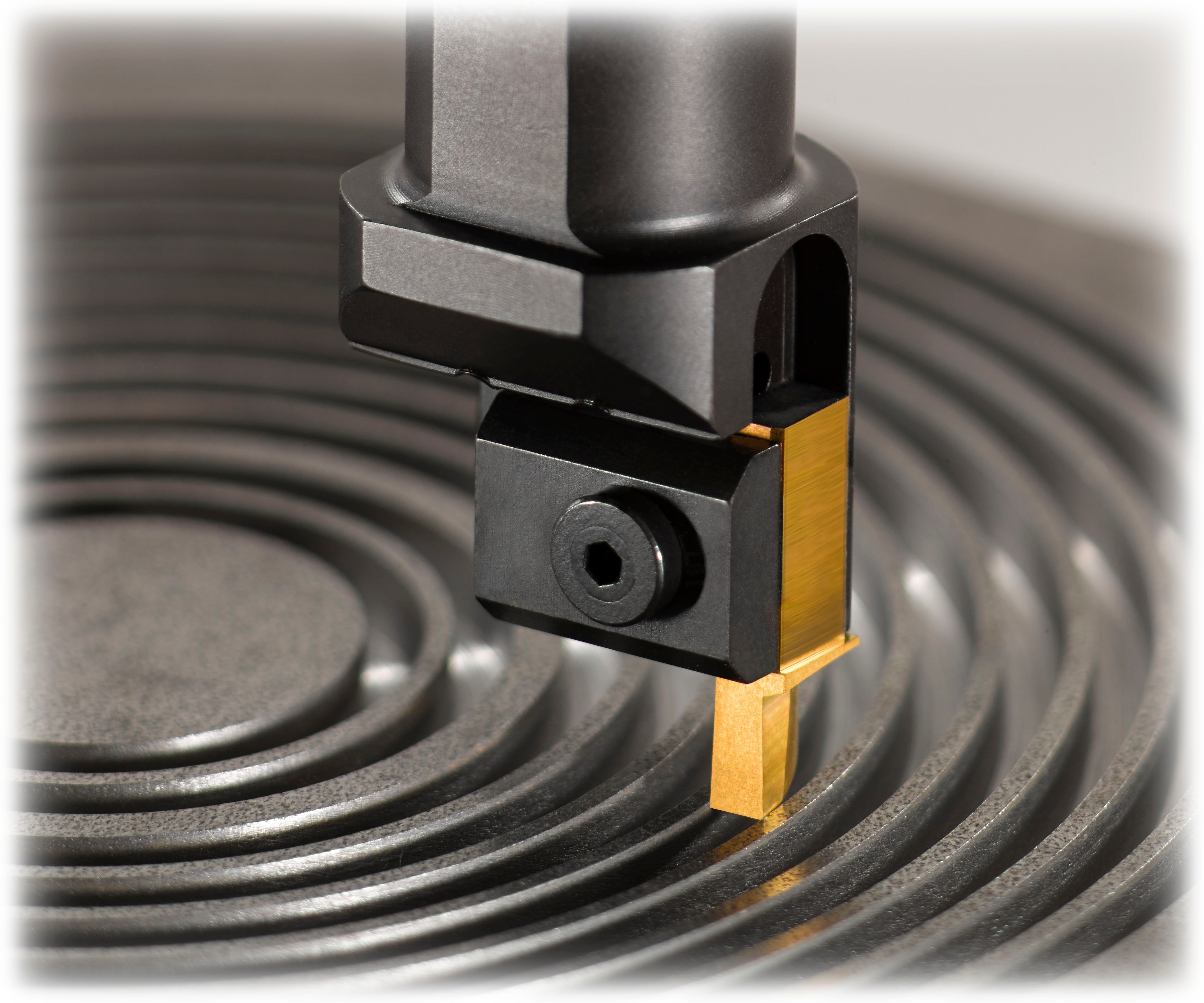
Thinbit will display its Mill A Groove line of toolholders and inserts at IMTS 2018.
Share


Phillips Corporation
Featured Content
View More
Phillips Corporation - Education
Featured Content
View MoreManufactured by Kaiser Tool Co., Thinbit’s Mill A Groove toolholders and inserts are designed to trepan on a CNC mill.
According to the company, capability for quality finish makes the tools ideal for sealing surfaces. Other advantages include the elimination of secondary lathe operations for face grooving; a large cross-section that provides strength, and the availability of custom inserts to match the groove form. In addition, groove diameters are concentric to spindle rotation, not table movement.


The inserts do not rotate about their own centers, so the groove can be symmetrical or asymmetrical. Step grooves, convex and concave radius grooves, chamfered edges, angles and special profiles can be made with a single insert.
When machining in 6061 aluminum, the line cuts a groove 0.125" wide × 0.200" deep × 4.98" in diameter in 18 seconds.
The toolholders are designed to work in combination with boring heads and are available in common sizes with straight and 90-degree orientations.
Inserts are available from 0.004" through 0.150" in 0.001" increments. Major diameters start at 0.300". Inserts are available in sub-micron grain carbide grades for ferrous and non-ferrous materials and HSS for composites and plastics. Inserts can be coated with TiN, TiCN, TiAIN or diamond film. PCD and CBN tipping options are available for hard or abrasive materials.
Related Content
-
Shop Tour Video: How to Integrate Additive and Subtractive Machining
Addman Advanced Metals has scaled from a single 3D printer to 25 while also building out a robust array of subtractive machines. In this video, find out how the shop manages its additive and subtractive workflows — and how it combines the two into a profitable niche.
-
Step by Step Guide: How to Choose the Right Threading Tap
From flute geometry to coolant channels, a step-by-step guide to selecting the right tap for better thread quality, longer tool life and more efficient machining.
-
How to Implement Zero-Point Workholding
The value of zero-point workholding systems is that your machine stops being tied to your setups. Once you see it that way, the day-to-day uses are easy to find.


