3 Mindset Changes for Lights-Out CNC Machining
Expanding capacity into the unattended hours calls for counterintuitive new ways of thinking about the work.

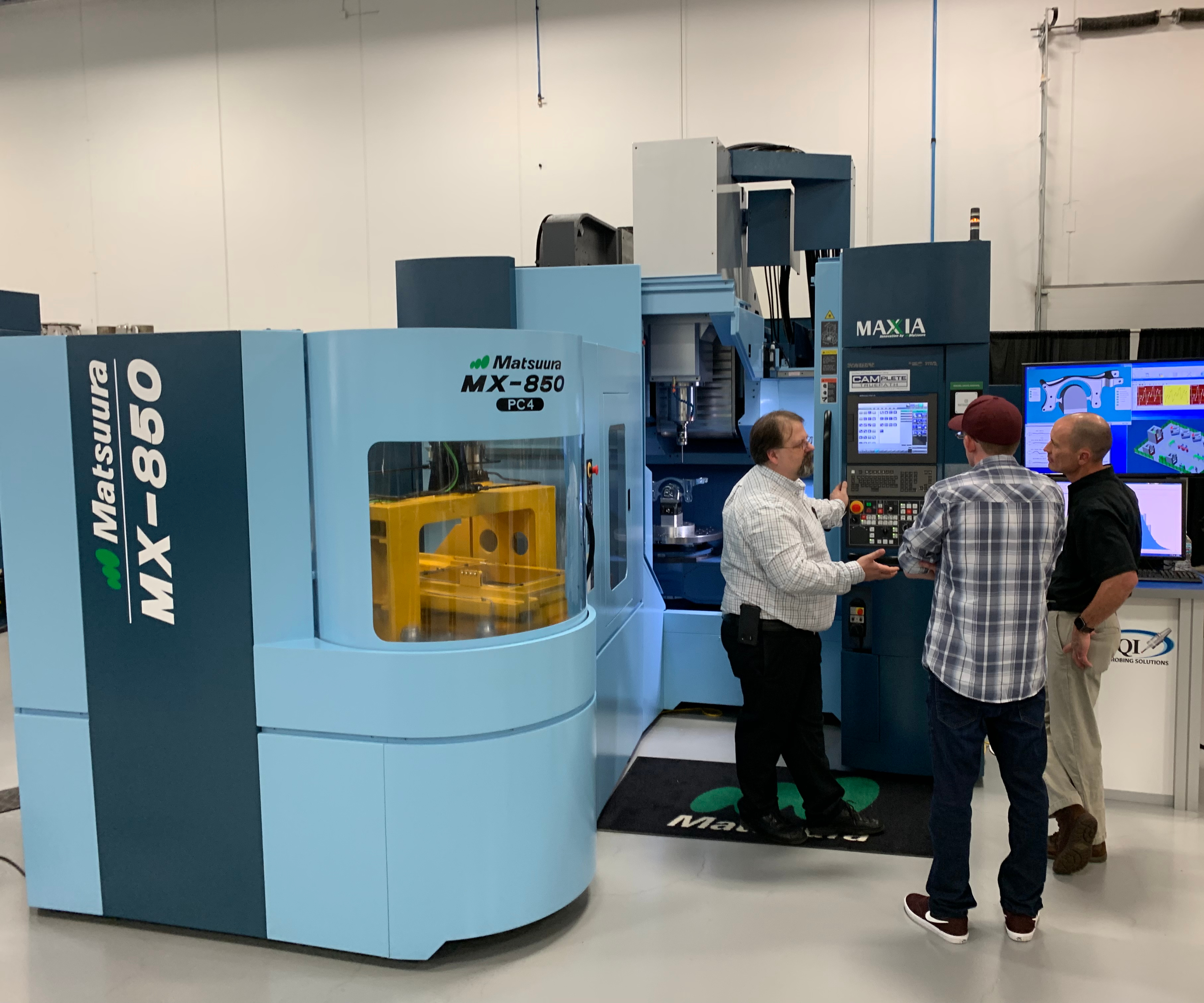
New to North America, Matsuura’s MX-850 is an example of machining automation that might represent the entry point into unattended, lights-out machining for many shops. Five-axis machining enables the machine to reach around a part for complete machining in a single cycle, and its four pallets and 120 tools allow enough work to be staged to run through an entire night shift. The largest machine in the company’s MX line. This model accommodates workpieces as large as 30 inches in diameter and 15.2 inches high.
Share


Phillips Corporation
Featured Content
View More


Phillips Corporation - Education
Featured Content
View MoreFor many machine shops today, the most promising avenue of potential expansion is not a new market or an addition to their facilities, but instead the untapped, unstaffed nighttime hours that could be captured for automated, “lights-out” production.
The daytime hours are generally full. Their limit is imposed by staffing. Shops with resources to expand are often challenged to find or develop personnel to keep pace. The answer, then, is equipment with less need for personnel—machines that can run unattended long after the staff has gone home. For many shops, though, equipment such as this represents a new and different type of machine tool than what the shop is accustomed to running, and using the equipment well calls for different assumptions.


Matsuura has seen this. The company supplies machining center systems served by automation. During a recent visit to the company’s U.S. headquarters in St. Paul, Minnesota, I saw examples new to the North American market and discussed how machines such as these differ from the equipment common in many shops. The most widely established type of CNC equipment is, of course, the small, standalone, three-axis vertical machining center (VMC)—a machine type that is challenged to realize any significant extent of unattended production. An operator typically needs to remain close to this type of machine, if only to keep feeding it new workpieces. By contrast, a machining center better suited to realize significant unattended production combines five-axis or five-sided machining to complete or nearly complete a part in a single cycle, along with pallet loading in order to enable a queue of work to be set up and staged for the machine. Matsuura’s U.S. president Craig St. John says demand for automated machining centers such as this has never been higher, but making full use of this type of machine requires a mindset shift in shops where machine tools generally run in proximity to a person.
Here are three counterintuitive ideas Mr. St. John and others with the machine tool company say might need to become second nature:
1. Run simple parts on high-end machines
“Keep it simple,” says Matsuura product manager Tyler Bonde. For a smaller shop buying a five-axis, pallet-fed machining center for the first time, this automated machine is likely to be the shop’s most expensive resource. The standard expectation says a high-value machine tool ought to run high-value parts. But this is potentially the wrong way to think about unattended machining, he says. In this case, the high-end machine tool likely should run the simplest parts. That is, it should run all the parts best able to run trouble-free without any operator nearby.
“Not every job is a candidate for unattended machining,” Mr. Bonde says. Some involve uncertainties or challenges that call for an operator to be close. “Run these jobs by day,” he says—possibly on less automated machines. The shop can then fill the nighttime hours with more straightforward and simple work, even if those parts are less valuable. Low-value work is frequently where automation makes its highest impact.
2. Slow down to do more
On a standalone machine tool, cycle time is key. But on an automated machine tool running unattended, reducing cycle time might no longer be the most productive aim.
“For automated machining, it’s not how quickly you can make a part,” says regional sales manager Fernando Garcia. “It’s what level of throughput you can maintain for a given availability of time.”
The distinction is subtle but important. The difference is consistency. The throughput for a given unattended time window might be lost if some unexpected event, notably a tool breaking, stops the machine while no one is around to restart it. Mr. Garcia says minimizing the likelihood of events such as this is pivotal for successful unattended machining, and achieving this level of reliability frequently involves slowing down so that the machining process is stable and tool wear is as predictable as possible. The side benefit of this is that both tool costs and scrap rate are liable to go down.
3. Find the most profitable hours after dark
Once a shop becomes established running productively without staff present, “You’ll want to run unattended all you can,” Mr. St. John says. In fact, the reasons go beyond the opportunity to find additional capacity. Another reason is that this capacity is almost certain to represent the shop’s least expensive machining work. Labor is a large portion of the cost of any part run in a process that requires an operator. Shops seeking to expand profitability thus have the equivalent of a low-cost alternate source to which they can turn. This low-cost provider is not an external subcontractor willing to do the work cheaply, but instead the same shop running differently during the part of the day when less labor is present.


Related Content

How a Family-Owned Tooling Company Competes with Global Giants (Includes Video)
Not ready to go digital? Consider this: With Siemens NX ecosystem, precision shop D’Andrea cut its programming time by 50% and is able to compete globally—even against industry giants.
Read More
10 Robotic Solutions You Can Find at IMTS 2026
Discover how today’s robots and cobots are making it easier than ever to automate tasks, free up skilled workers, and run machines unattended – even in small and midsized shops.
Read More
Inside a CNC-Machined Gothic Monastery in Wyoming
An inside look into the Carmelite Monks of Wyoming, who are combining centuries-old Gothic architectural principles with modern CNC machining to build a monastery in the mountains of Wyoming.
Read More
Add Flexibility and Speed to Your Operation with Next-Generation Robotics by Okuma
Okuma’s second generation of robotics loaders incorporates updates that enable flexibility and faster processing time for any manufacturing operation. This holds true even for shops with no prior automation experience.
Read MoreRead Next

Running Unattended at Night Lets Machine Shop Serve New Customers During Day
Precision Tool Technologies found capacity for diversification not by adding machines, people or space, but by freeing up time. Running unattended—running so it can machine through all 168 hours in the week—has enabled this shop to use hours when staff is present to deliver work that lands outside its established specialty. To achieve unattended machining, some of the biggest challenges have related to basic details such as chips and coolant.
Read More
The Unattended Effects of CNC Machine Shop Automation
Automated machining and data collection have helped Custom Tool to not only grow its business through more lights-out production, but also to establish a continuous-improvement mindset that has enabled it to become more efficient in numerous areas.
Read More
WEBINAR: From Machine Data to Guided Action: How Modern Shops Are Closing the Execution Gap
In this webinar, MachineMetrics Product Manager Josh Fish is joined by Pindel Global Precision's Thomas Deslongchamps, for a candid look at what closing the execution gap actually looks like inside a precision machining shop.
Read More


