
Accurate Digital Manufacturing Tool for 3D Printed Parts
Warp-Adapted-Model uses full-part 3D data from an initial part to identify errors and produce a new, corrected model in minutes.

Share


Phillips Corporation
Featured Content
View More


Phillips Corporation - Education
Featured Content
View More


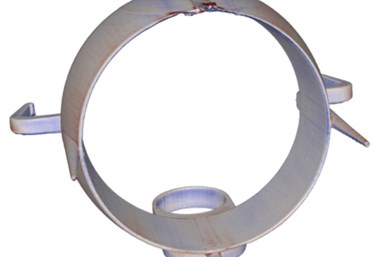
Riven, a leader in 3D reality intelligence for digital manufacturing, has developed Warp-Adapted-Model (WAM) capability that is said to enable higher accuracy additive manufacturing (AM) part production. WAM uses full-part 3D data from an initial part to identify errors and produce a new, corrected model in minutes. According to Riven, the resulting model eliminates warp and is up to 10 times more accurate when printed.
WAM capability has been tested extensively and has shown improvement across a wide variety of additive manufacturing technologies including fused filament fabrication (FFF), stereolithography (SLA), metal binder jetting and multi jet fusion (MJF). WAM is said to improve parts made by nearly any AM technology or machine, including legacy equipment.


WAM works for any additive technology without the need for detailed knowledge of the specific machine or material parameters. WAM is complementary to simulation-based approaches and can be used alone or in combination to correct remaining errors related to environmental conditions or imperfect simulation input.
In a comprehensive FFF trial, average print errors were reduced by over 2.8 times where the accuracy score improved from 80% to 93% (where errors are defined as areas with deviation over 0.25 mm). Trials were conducted with three different part types and in three different materials.
According to Riven, WAM is scalable, making additive manufacturing a viable option for customers with projects that only need a few units to those that require thousands or more. Riven is developing joint solutions with leading AM equipment and additive manufacturing of electronic systems (AMES) partners to open new markets for AM production across industrial, automotive, aerospace and consumer applications.
Riven is also pre-release testing PWAM, a predictive, machine-learning driven version of the technology which creates pre-adjusted models automatically and will deliver even greater economies of scale and minimize production of scrap parts.
Related Content
-
Vertical Integration, Automation Helping 3D Printed Spine Implant Manufacturer Scale Production
How did a leading spine implant manufacturer leverage 3D printing to compete on cost with CNC machining? Learn how advanced additive manufacturing techniques are redefining material efficiency and geometric complexity in medical devices.
-
How Additive Can Complement Subtractive Manufacturing
Think of additive and subtractive as complementary processes, rather than being in opposition.
-
Where Art & Tech Collide: Martin Guitars, Mazak, Renishaw Talk Friezing, Guitars
IMTS 2024: On the IMTS+ Main Stage, Martin & Co. is highlighting its collaboration with Mazak and Renishaw to create an automated friezing process in its manufacturing of guitars.


