
Takumi Bridge Mill Boost Performance in Die/Mold Applications
IMTS 2026: Takumi USA showcases the H12E machining center, demonstrating the machine's capabilities by cutting a forging die.
Share


Phillips Corporation
Featured Content
View More
Phillips Corporation - Education
Featured Content
View More


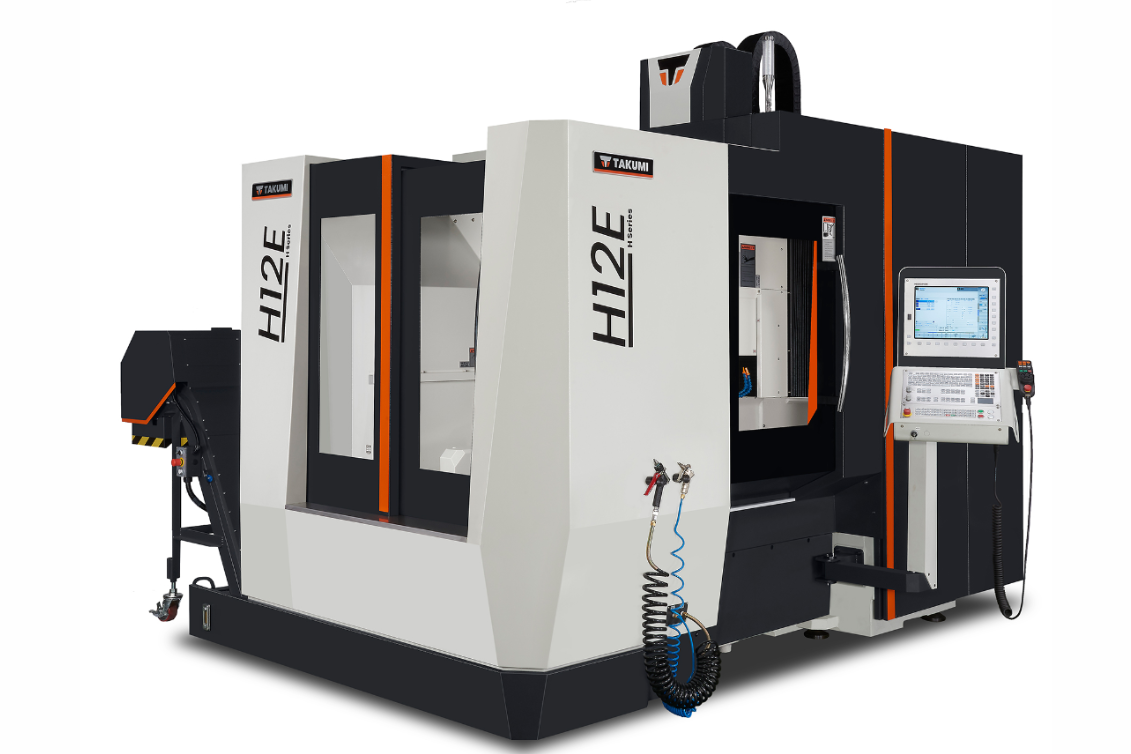
Takumi’s H12E bridge mill is well-suited for die/mold applications with demanding accuracy and surface finish requirements. The H12E incorporates a range of design features and technologies designed to boost performance. Takumi demonstrates the machine’s capabilities by cutting a forging die.
To maximize stability and rigidity, the H12E’s bed, column and cross-rail are created from a single-piece frame with no weldments. The cross-rail saddle carries a constant weight, enabling fast cutting speeds with no compromise to surface finish. In addition to minimizing vibration, the machine’s design maintains close positioning of the spindle to the bridge to reduce overhang.
Featured Content


A Big Plus CAT 40 direct drive spindle provides a maximum speed of 15,000 rpm via a 25-hp motor. Takumi’s iSpinII intelligent thermal compensation system counters ambient temperature variations to promote consistently high levels of precision. Temperature-controlled, direct-coupled ballscrews further improve repeatability, while linear scales on all axes allow exact positioning.
Offering the largest Y-axis travel in its class, the H12E includes X, Y and Z travels of 49.2" × 37.4" × 22.8". Capable of accommodating parts to a maximum weight of 4,400 lbs, the machine provides a solution for the production of large components.
The H12E offers extra wide door openings to allow easy part loading and unloading, and large windows provide high visibility into the work envelope. The H12E features a FANUC 0i Plus or Heidenhain TNC7 control as standard, with a Siemens Sinumerik One control available as an option.
Connect at

Related Content
-
Video Tour: Inside the American Precision Museum
Where did precision manufacturing begin in the U.S.? What led to it, and how has it changed? Join us on this tour of the American Precision Museum, where Executive Director Steve Dalessio tells us the story of precision manufacturing’s birth — right from the place where it happened.
-
When to Use 3+2 Versus Full Five-Axis for Finishing Operations
Consider the entire system — along with your goals — when deciding between a full five-axis or a 3+2 approach.
-
Automation is for Everyone
Not just for large shops, automation can help even the smallest shops solve labor challenges and become more profitable and efficient.


