Taco, Inc. Streamlines Cleaning with an Inline System
Alliance Manufacturing created a customized inline system that allows Taco, Inc. to eliminate manual cleaning and produce a consistently clean and dry part.
Share


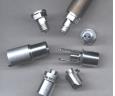
Parts on conveyor(s) in wash zone with machine canopy removed.

Load area prior to entering the wash zone. Exhibits the dual conveyors, conveyor “A” flat wire belt on left, Conveyor “B” dual chain on right.

Operator Safety, Throughput and Quality Compromised
Cleaning machined castings is not a new venture for the people of Taco. Over the years, they have successfully tackled several difficult cleaning applications. Manufacturing engineers, Bill Young and Joe Hutchins recognized that there were throughput issues with the cleaning and drying operations on the FloChek and SwetChek machining lines. These products are cast from iron or bronze and are machined to specification. FloChek and SwetChek are used as weighted check valves in hydronic heating applications, allowing system flow in only one direction.The FloChek and SwetChek components are turned on a CNC lathe, bored and threaded prior to cleaning. At first, the parts were sent to an older carbon steel rotary style wash and dry machine. According to Young, “the machine had not run properly for sometime.” The machine would not cycle correctly and the wash cycle had to be turned off completely in order for the dry cycle to function. “We had to resort to manually washing the parts, which was very labor intensive,” Young said. After cleaning, they would then load the parts into the rotary style machine, using it for the drying cycle only. This process raised safety concerns and hindered their pro-duction throughput. Manual washing reduced production output by nearly 5 percent and resulted in ergonomics issues for the operator.
Defining the Requirements
Young and Hutchins started to define the general system requirements. They formed a buying team consisting of first and second shift operators, assemblers and supervisors, and worked on creating a specification for a new system. The team outlined the general parameters of the machine and asked the companies that were giving them quotes to make recommendations. The system needed to be capable of removing coolant residue from the machined bodies as well as cast iron and bronze chips from the interior passages. The goal was to produce a clean part that was chip-free and dry within five minutes of exiting the machine. Due to the nature of the machining process, centrifugal force can wedge fine chips into the crevices of the parts, making them difficult to remove. The team felt that by using a heated spray wash cycle with strategically placed nozzles, the chips would be dislodged. An ambient air blowoff would remove the gross amounts of moisture and the residual heat from the wash process would aid in flash drying prior to assembly.One of the challenges related to the application was the wide variety of part configurations that needed to be cleaned. The cast iron FloChek had five part sizes and the cast bronze SwetChek had another two. Each part number had varying volumes over an 18-hour production cycle. Originally, the team specified that the machine be a turntable configuration with wash and blowoff cycles. They also required that the parts be placed in baskets or carriers to keep the components from being knocked over during the cleaning cycle. The hope was that the parts could be loaded in a batching system and wash/dried in one step, prior to being transported to assembly.
Another requirement was that the machine be flexible and allow the operator to control wash cycle time, blowoff time and water temperature. The base design required that the spray nozzles and air knives be positioned to accommodate all part variations. In addition, Taco did not want the operator to have to make adjustments in positioning when changing from job to job. Each vendor was asked to follow the guidelines presented and recommend the best fit solution for the project.
A Different Approach Uncovered
Taco contacted different parts cleaning equipment manufacturers and started the equipment selection process. One of companies Taco approached was Alliance Manufacturing, Inc. (Fond du Lac, WI.) Alliance is a manufacturer of a wide variety of standard designs and custom engineered water-based parts cleaning systems. Alliance’s president, Jeff Brouchoud had experience working on projects similar to Taco’s, and decided to handle the project personally. In an attempt to work within the constraints set by Taco, Brouchoud reviewed the production volume, part variations, contamination and handling and decided to quote a dual rotary table type machine. Brouchoud felt that the dual table design would have several noticeable benefits. Alliance would achieve greater surface coverage and impingement of both wash sprays and blowoff. The cast iron and cast bronze components could be kept separate. In addition, the design could accommodate existing baskets that were currently being used by Taco.The initial concept was well received, but Young raised the question, “might there be another way to handle these parts? Is it possible that an inline system would work?” This essentially wiped the slate clean for Alliance. There were discussions of a pass through system, but custom parts baskets may be needed to ensure proper part orientation. After review-ing the production volume and line speed, it was determined that the machine would not fit within the allotted work space. Alliance had another idea— a dual inline conveyor system in which the parts would travel directly on the conveyor. This would allow the process zones to be shortened and the machine would fit the required space limitations. Considering that there were several different parts configurations, Alliance needed to determine the best possible method to convey the parts through the machine. In addition, the spray system needed to be designed in a manner that would provide the required spray coverage and impingement to insure chips located in internal passageways would be dislodged. Alliance put together a concept drawing using the Alliance Aquamaster CB-1800E conveyorized cleaning system as the base machine. Then, Alliance proceeded to modify the interior to include two different conveyors within the ma-chine. Conveyor “A” is a stainless steel six-inch-wide flatwire belt, with half-inch by one inch openings. Conveyor “A” is designed to handle four of the five FloChek part configurations. In addition, the parts are automatically removed from the conveyor by a “finger” like transfer plate. The parts are stripped from the belt, travel down a transfer slide and are held in a part accumulation area. Conveyor “B” has dual strand stainless steel chains supported by UHMW guides. Parts are placed directly on to the chains and are conveyed through the system. Conveyor “B” was designed to accommodate the smaller SwetChek parts and the smallest FloChek part. This conveyor also included a custom designed part strip off and part accumulation area.
A Team Effort Pays Off
Although the system supplied was not as originally envisioned, the people at Taco, Inc. were very pleased with the final outcome. The Alliance customized Aquamaster CB-1800E inline system solved all of the issues related to the previous method of cleaning. Taco was able to eliminate manual cleaning and produce a consistently clean and dry part. The machine also decreased cleaning cycle time and reduced material handling. Unlike a batch type system, the inline unit can be loaded by the machine operator and conveys parts to an accumulation area where it can be retrieved by the assembly people. “The operator simply places the part on the wash conveyor and says ‘good-bye’ to it; he doesn’t have to handle it again,” Young said. Taco was very pleased with the system and the flexibility of the people at Alliance. “We did an automated cell with Alliance two-and-a-half years ago and we really enjoyed the professional nature of their engineering people and Jeff Brouchoud. That last project was a lot more technical in nature because it was fed by a Fanuc robot. We were constantly moving the target on both projects and Alliance never made our requests feel like a pain for them,” Young commented. “Taco has strived to become a world class manufacturing organization. We have done so by partnering with world-class companies such as Alliance. We currently have two other projects in process with Alliance and are confident that the experience will be as pleasant.”Ken Manninen is the vice president of Alliance Manufacturing, Inc. Alliance manufacturers a wide variety of standard and custom engineered parts cleaning equipment. For more information regarding Alliance please contact Jeff Brouchoud at (920) 922-8100; (800) 969-7960, or visit the Web site at www. alliancemfginc.com.


Read Next

OEM Tour Video: Lean Manufacturing for Measurement and Metrology
How can a facility that requires manual work for some long-standing parts be made more efficient? Join us as we look inside The L. S. Starrett Company’s headquarters in Athol, Massachusetts, and see how this long-established OEM is updating its processes.
Read More