
Reducing Chatter and Strain Through Pressure Monitoring
Loss of fixture pressure can cause problems from chatter to thrown parts. Pressure monitoring helps keep fixtures stable and operations on target.

Share


When a fixture loses pressure, the best-case scenario is chatter. The worst is that a part could become a projectile. A good way to avoid both, says Eric Roth, Vektek’s vice president of sales and marketing, is equipping fixtures with a pressure monitoring system.
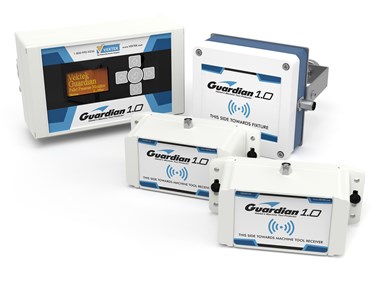
The Vektek Guardian 1.0 momentary pressure monitoring system consists of three components: a master control unit (top-left), a fixture transfer unit (the two lower devices) mounted on palletized fixtures and a machine tool receiver (top-right) that uses Focus Field technology to communicate with fixture transmitter units. Image courtesy of Vektek.
Why is Pressure Monitoring Important?
Roth says pressure monitoring helps promote four key concerns on the shop floor: maintenance, part quality, safety and profitability. Oftentimes, it meets several of these concerns simultaneously.


For example, pressure monitoring detects when leaks weaken a fixture’s grip on a part, enabling users to pause production before chatter occurs. As chatter is the fastest way to shorten tool life, Roth says, reduction of chatter can sometimes pay for these systems by itself, especially when it enables shops to securely keep their machines’ spindles running overnight. It also saves on major repair work and replacement costs for fixtures that could be damaged by chatter, and eliminates a common source of part damage.
The ability to remotely monitor pressure also cuts back on the need for users to enter the machine tool and inspect fixtures that have already been pressurized. This not only saves time, but Roth points out it reduces operator fatigue and lowers the risk of injury on coolant-slicked machinery. It also cuts back on machine maintenance, he says, by reducing the number of intrusions users need to make into the workholding device (and thereby reducing the number of opportunities for contaminants to enter coolant or cutting oil).
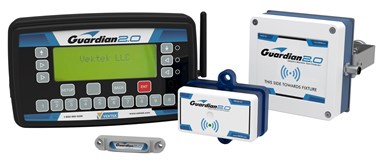
Vektek’s Guardian 2.0 continuous pressure monitoring system has wirelessly paired master control units (top-left) and fixture transmitter units (middle), as well as pallet ID tags (bottom) affixed to individual fixtures and a pallet ID reader (top-right) inside the cutting envelope to determine active pallets. Image courtesy of Vektek.
Momentary and Continuous Pressure Monitoring
Roth categorizes pressure monitoring systems as on-demand, momentary systems that check the pressure of a fixture at a given moment, and continuous systems that provide constant insight into a fixture’s pressure.
Momentary systems, such as the company’s Guardian 1.0 system, are a bit simpler to set up. Roth recommends his company’s version of this system for load stations and pallet staging areas (while acknowledging that they can work elsewhere), and notes that the user side of the system does not need to be complicated. After setting up data collection units on palletized fixtures and an RFID reader for these systems, the control unit only needs power wires and an alarm wire. Roth himself calls it “a really fancy light switch,” off when pressure is normal and energized when pressure readings are abnormal. The alarm wire can activate one of several alarm responses, the most common of which Roth says are M-codes to stop a machine, E-stop shutdown commands, and visual and audible alarms.
These same alarm responses apply to continuous pressure monitoring systems like Vektek’s Guardian 2.0 system. These systems work best when measuring inside the machine tool, which requires more flexibility than momentary monitoring systems. Vektek’s take on continuous systems uses tags equipped with wireless signals, which enable users to distinguish between them, as well as a device inside the machining envelope to tell the system which fixture needs to be at its pressure threshold or alarm out.
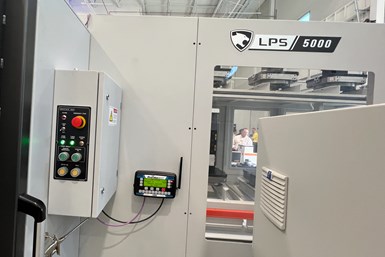
Wireless, continuous pressure monitoring systems are a recent arrival on the market, Roth says. Vektek debuted the Guardian 2.0 system at IMTS 2024, and is partnering with machine tool OEMs to offer it integrated with their equipment. Image by Modern Machine Shop.
Considerations for Implementation
Roth says both systems have their use cases, and choosing between them largely comes down to the goals and expectations of a shop’s different departments. Namely, he says, what kind of goals the maintenance, part quality, safety and accounting teams have for the equipment — and what kind of a dollar value they see in each.
Similarly, the teams should agree on which alarm conditions (M-codes, audible alarms and so on) to use prior to purchasing a system. Roth also notes that it is important for a shop’s teams to agree on what comes after an alarm. That is, questions like who needs to be notified, who needs to inspect the fixture, what the alarm report looks like and who receives it, and how the machine will be restored must all be answered to have a functioning, profitable pressure monitoring system.


Related Content

The Future of High Feed Milling in Modern Manufacturing
Achieve higher metal removal rates and enhanced predictability with ISCAR’s advanced high-feed milling tools — optimized for today’s competitive global market.
Read More
Shop Reclaims 10,000 Square Feet with Inventory Management System
Intech Athens’ inventory management system, which includes vertical lift modules from Kardex Remstar and tool management software from ZOLLER, has saved the company time, space and money.
Read More
Briquetting Manufacturer Tools Up for Faster Turnaround Times
To cut out laborious manual processes like hand-grinding, this briquette manufacturer revamped its machining and cutting tool arsenal for faster production.
Read More
Revolutionizing Production: How Smart Hydraulics Drive 24/7 Manufacturing Excellence
All World Machinery Supply helps a firearms manufacturer up its game and improve and increase output.
Read MoreRead Next

Fixture Feedback Keeps Automation Accountable
Self-validating hydraulic workholding keeps processes reliable and limits the need for on-machine probing.
Read More
DN Solutions Technical Hub Promises Efficiency Across Operations
Efficiency cannot be achieved focusing on it only at a micro level; it must be addressed at organizational, shopfloor, and individual machine scales. Find out how DN Solutions is doing so from its recently opened Technical Center in Schaumberg, Illinois.
Read More