Kitamura
Published

VMC, Pallet System Keep Work Flowing

A Haas VMC with a Midaco pallet changer not only freed additional capacity on the HMCs this shop uses for tight-tolerance production work, but also reduced cycle times in some cases.
Share

Leaders-In background


Opting for a Haas VMC and Midaco automatic pallet changer (APC) rather than another HMC has paid off for K & G Manufacturing Company—literally. For less than 25 percent of the purchase price of an HMC, the system has not only freed additional capacity on the HMCs traditionally used for high-tolerance production work, but also reduced cycle time in some cases.
 
Harry Kane and Sid Gerbig founded K & G in 1937 as an automotive parts distributor serving dealerships and service centers. They added a machine shop to the business at the beginning of World War II to produce parts for the war effort. By the mid ‘50s, the company had switched to manufacturing tools, dies, jigs, fixtures and special machinery. A decade later, it expanded into full production-machining services. Today, its 60-plus employees work to produce parts for the aerospace, defense, marine, computer and medical industries.
 
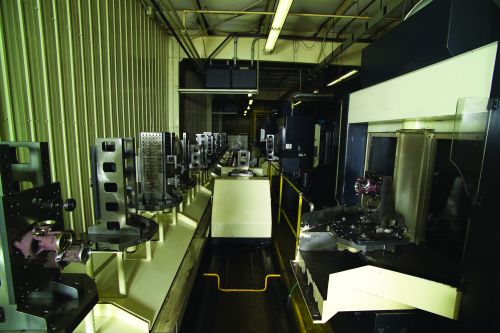
The company’s 41,000-square-foot, climate-controlled facility is home to four HMCs serviced by a 30-pallet, flexible manufacturing system (FMS); three standalone HMCs; three standalone VMCs; seven lathes; and one twin-turret, twin-spindle lathe. It also houses a tool crib where all loading is preset, a quality department with two CMMs, a deburring department, a pressure-testing department and an assembly department.
 
The problem that led the company to purchase the new VMC and APC involved the four-HMC FMS. “The four machines were all booked, some running computer circuit board parts, and we needed to offload some of this work to make room for additional tight-tolerance parts,” says Dean Turek, K & G production supervisor. “Even though we run a lot of aerospace parts, we figured we did not need to run all those parts on the horizontals to get the tolerances we needed.”
 
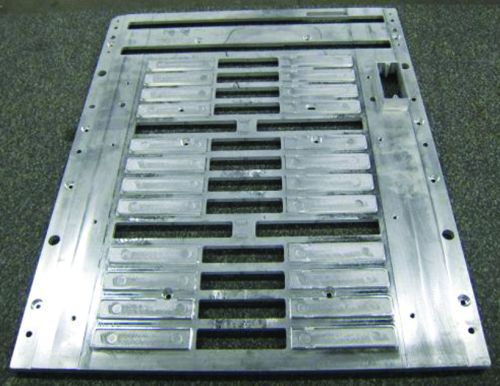
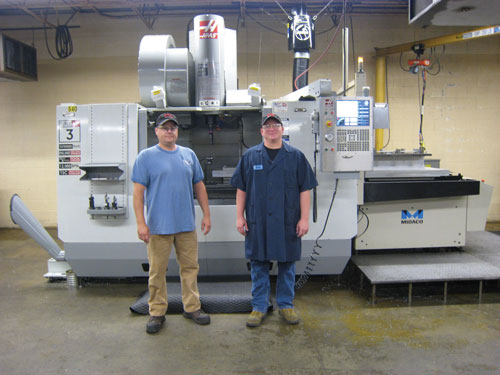
Seeking a less-expensive VMC, the company decided on a package consisting of a VF3SSYT VMC from Haas Automation (Oxnard, California) and a A4025SD APC with cast-aluminum pallets from Midaco (Elk Grove Village, Illinois). Since installation, the system has been used to run both low- and tight-tolerance work as well as both aerospace and non-aerospace parts—in some cases even faster than the HMCs, Mr. Turek says. As an example, he cites a three-minute cycle time improvement on the aforementioned circuit board components. As for the lower cost of this system versus another HMC, “That type of savings is huge in helping us stay competitive,” he adds.
 
For further time savings, the company purchased four additional pallets and set up a pallet storage area with a transfer cart for moving them between the storage area and the machine. This setup enables staging jobs offline and transferring the pallets to the machine when ready. The fact that the pallets provide repeatability accuracy within ±0.0001 inch makes this strategy especially useful for significantly limiting downtime between jobs, Mr. Turek says. Operators can typically swap out both pallets on the Midaco shuttle within 5 to 10 minutes.
 
The next time the company installs a VMC, it will explore the idea of putting a pallet changer on both sides of the machine instead of just one side, Mr. Turek says. Having a shuttle on both sides would make four pallets available for immediate use, thereby enabling the machine to run longer without operator attention. Considering plans are in the works to replace some aging VMCs on the shop floor, this is likely to happen, Mr. Turek says. “We wouldn’t just buy another vertical machine alone. It will be purchased with a Midaco. That’s not even a question.”


Kitamura
DN Solutions
paperlessPARTS
Gravotech
IMTS 2026
EMUGE FRANKEN
YCM Alliance
Dimensional Air Gage Specialists

Related Content

Automation

Medical Shop Performs Lights-Out Production in Five-Axes

Moving to five-axis machining enabled this shop to dramatically reduce setup time and increase lights-out capacity, but success relied on the right combination of workholding and automation.

Read More

Ballbar Testing Benefits Low-Volume Manufacturing

Thanks to ballbar testing with a Renishaw QC20-W, the Autodesk Technology Centers now have more confidence in their machine tools.

Read More

The Benefits of In-House Toolmaking

The addition of two larger gantry routers has enabled a maker of rubber belting products to produce more tooling in-house, reducing lead times and costs for itself and its sister facilities.

Read More
Five-Axis

Five-Axis Machines Speed NASCAR Engine Production

Moving from an aging set of five-axis mills to more advanced machines enabled Hendrick Motorsports to dramatically improve its engine production.

Read More

Read Next

Inspection and Measurement

OEM Tour Video: Lean Manufacturing for Measurement and Metrology

How can a facility that requires manual work for some long-standing parts be made more efficient? Join us as we look inside The L. S. Starrett Company’s headquarters in Athol, Massachusetts, and see how this long-established OEM is updating its processes.

Read More
Kitamura