
Rollomatic Unveils Double Rough Pinch Grinding Process
Rollomatic has debuted its double rough pinch grinding process, which it says cuts cycle times and increases performance and thermal stability.

Share


Phillips Corporation - Education
Featured Content
View More


Phillips Corporation
Featured Content
View More


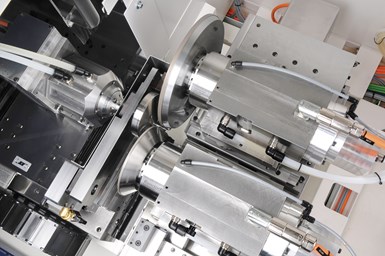
Rollomatic, the original inventor of pinch and peel grinding, has developed a new “double rough pinch grinding” process to decrease cycle times for blank preparation of several carbide cutting tools.
Pinch grinding specializes in blank and tight surface finishes. The roughing and finishing wheels grind parts simultaneously, with the finishing wheel trailing the roughing wheel to perform both rough and finish grinding in one pass and reduce cycle times.


In double rough pinch grinding, users equip both grinding stations with diamond wheels with a grit size normally used for rough grinding. This leaves the blank “pinched” between two rough-grit diamond wheels, which then work simultaneously on the blank. While one wheel does the majority of the work, the second wheel cleans up what was left. This process further shortens the cycle times of the customary pinch grinding method.
Rollomatic recommends its new process when preparing T-slot cutters, thread end mills, end mills for die and mold machining, long-reach end mills and rotary burs. It also recommends the process for long-batch production.
Both grinding spindles are synchronous direct‐drive spindles with 19 hp peaks. The most important feature of a synchronous motor is that it provides constant speed during its operation with an efficient torque curve. Synchronous motors always run equal to their synchronous speed, as opposed to less-efficient asynchronous motors (induction motors) which always have a lag.
On a test production run of 100 pieces, the process achieved a cycle time (without loading or unloading) of 5 minutes and 5 seconds. Wheel spindle load never broke 35 percent, with wheel wear as the limiting factor rather than the machine. At a 35-percent power draw, the spindles did not release heat into the machine or grinding process – improving thermal stability. Rollomatic says the process outperformed alternative competitive equipment by 50 percent.
Related Content
-
Is AI Ready to Tackle High-Mix Grinding? Interview with GrayMatter Robotics Co-Founder
GrayMatter Robotics co-founder Satyandra Kumar Gupta explains how the company’s AI-powered Scan&Grind system tackles weld blending, surface finishing and gate removal on metal parts — and why embodied intelligence is key to automating grinding in high-mix environments.
-
Seeking Custom Grinding and Automation with Weldon Solutions
Weldon Solutions is demonstrating three grinders at IMTS 2024. Though they differ in size and use case, all feature the company’s hallmark customizations.
-
How Precision Blanks Help This Aerospace Shop Build Better Parts
Internal stress in thin metal parts can lead to warped components and scrapped work. Matrix Machine found a better way by sourcing precision-ground blanks from TCI Precision Metals. Here’s how that decision freed up capacity and made critical parts more predictable.


