
Investment Casting Builds Lightweight Airplane Seat Frames
The frames could have been 3D printed in metal, but for economic production, investment casting proved to be the best option.

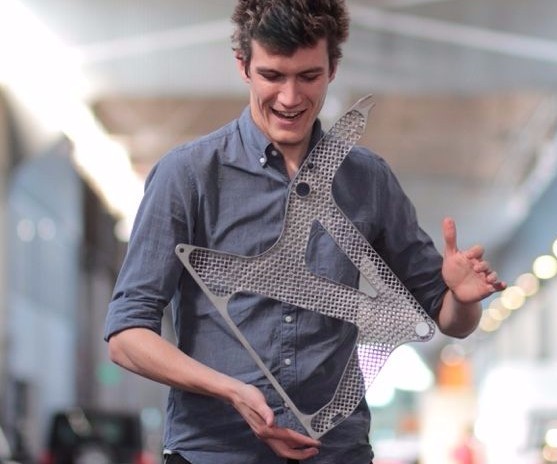
This lightweight airplane seat frame may look like something that was 3D printed, but in fact it was manufactured using a very old technology: investment casting.
Share


Phillips Corporation
Featured Content
View More


Phillips Corporation - Education
Featured Content
View More

Lattices, organic designs and lightweight parts are all keywords commonly associated with the promise of additive manufacturing (AM). But sometimes these features and attributes can also be achieved through more conventional means. A recent project undertaken by Autodesk illustrates this point, using a very old technology: investment casting.
The goal of the project was to produce an airplane seat frame that would be lighter than the original design but just as strong. The initial design, featuring an organic lattice structure, was intended to be 3D printed in aluminum, but the cost of this process and the part’s size led researchers to look elsewhere for a manufacturing method.
Investment casting proved to be the best choice, as it is better understood, offers more material options and was more economical for this part than 3D printing. However, like 3D printing, investment casting still enables the production of complex geometries. The research team was able to keep the latticed seat frame design, but had it cast in magnesium for a total cost savings of 56 percent over conventional aluminum seats.
Although 3D printing wasn’t used as the production technology, it did play a role in the investment casting process. Read the full story on additivemanufacturing.media to learn more.
Related Content
-
Video: 3D Printing Consolidates Assembly, Reduces Cost for Bar Feeder Component
At IMTS 2024, 3D printer supplier One Click Metal highlighted how its low-cost metal printer can help improve machining, showcasing components for Index bar feeders that were redesigned for additive.
-
OEMs Showcase Hybrid Manufacturing Applications
Mazak and Mastercam worked together to demonstrate the viability of hybrid additive/subtractive machining techniques at a recent event held in Florence, Kentucky.
-
How to Meet Aerospace’s Material Challenges and More at IMTS
Succeeding in aerospace manufacturing requires high-performing processes paired with high-performance machine tools. IMTS can help you find both.


