
Key Elements of the World’s Largest Inverted VTL
A number of noteworthy design elements enable this inverted vertical turret lathe to accurately and effectively machine very large components.

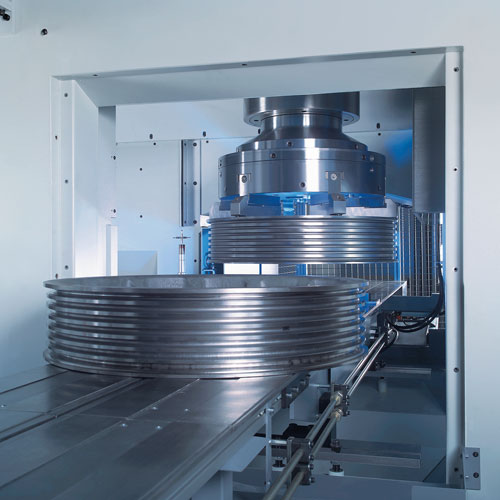
The VLC 1200 inverted vertical turret lathe can pick up and machine 1,500-kg workpieces with diameters as big as 1.2 meters.
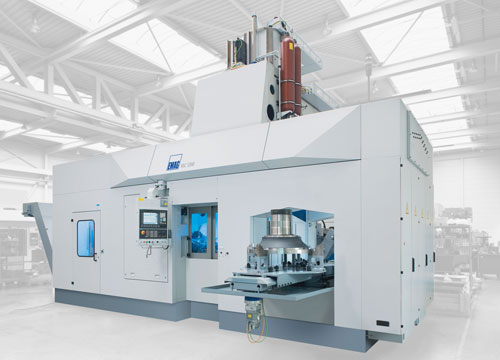
The machine has a more compact footprint than other automated machining systems because no auxiliary loading equipment is needed.

A touch probe mounted to the machine’s stable, polymer-granite base serves as an in-process gage to measure workpieces to an accuracy of ±2 microns.
Share


Phillips Corporation
Featured Content
View More


Phillips Corporation - Education
Featured Content
View MoreInverted vertical turret lathes (VTLs) are distinctive in that they serve as their own parts loader, using their downward-facing main spindle to pick up staged workpieces and deliver them to the machining zone. This yields a more compact footprint than other automated machining systems because no auxiliary loading equipment is needed. And because the spindle carrying the workpiece is positioned vertically above the tools, hot chips fall unhindered into a conveyor, preventing them from contaminating the machine’s main spindle or collecting upon and heating up the workpiece.
Emag’s multifunction VLC 1200 is said to be the world’s largest inverted VTL. It can pick up and machine 1,500-kg workpieces with diameters as big as 1.2 meters. Such large-part machining capability makes the VLC 1200 well-suited for manufacturing precision components used in construction machinery, industrial transmission systems and wind-turbine generating systems. Plus, the machine can perform multiple operations in a single setup, including turning, drilling, milling, grinding and gear cutting. This flexibility improves throughput while minimizing work-in-process as well as transport of big, bulky components throughout a manufacturer’s facility.
Featured Content


A number of noteworthy design elements enable the VLC 1200 to accurately and effectively machine very large components. Here are a few:
• Polymer-granite machine base—The VLC 1200 features a portal design with a U-shaped base made of a polymer-granite material called Mineralit. This engineered granite offers many benefits over traditional welded steel or cast iron beds. For instance, the material’s inherent stability mitigates thermal distortion traditionally observed in a steel or cast iron base. This is also why the polymer-granite material is 30 percent more effective in damping vibration compared to traditional base materials, according to the company. Less system vibration leads to better surface finishes and longer tool life while enabling aggressive cutting parameters.
• Fluid-cooling system—Although the VLC 1200’s bed is made of polymer granite, other critical assemblies have steel or cast iron frames. One example is the cast iron main spindle carrier that spans the top of the U-shaped base to create a box-frame structure with minimal component overhang. A closed-loop coolant system ensures that the spindle carrier as well as the turret, feed axes and other such components maintain a consistent temperature to ensure thermal stability.
• Powerful milling spindle with beltless drive—The machine’s milling spindle is located below the main spindle. It offers as much as 52 kW of horsepower and has an HSK A100 interface for heavy cutting applications. According to the company, a beltless-drive design eliminates backlash, feedback error and vibration to deliver quality surface finishes and precise geometries.
• On-machine part probing—A touch probe inside the machining area serves as an in-process gage to measure a workpiece still clamped in the machine to an accuracy of ±2 microns. Nominal corrections based on probe feedback are made automatically to the part program as necessary. The probe can also be used for measuring a semi-completed part feature after a tool change (before the machining operation reaches full depth). This is especially useful when machining large parts that require multiple identical tools to create a given feature.
Because the probe is mounted directly on the machine’s polymer-granite bed, its position with respect to the machine will not change due to thermal fluctuations (unlike probes installed on moving arms). A fixed probe location also offers a known home position, which simplifies machine calibration routines.


Related Content

Top Shops: Designing a Shop to Meet Customer Needs
Working closely with customers and making careful investments has enabled this Wisconsin machine shop to tackle difficult jobs with tight deadlines as a core part of its business.
Read More
Add Flexibility and Speed to Your Operation with Next-Generation Robotics by Okuma
Okuma’s second generation of robotics loaders incorporates updates that enable flexibility and faster processing time for any manufacturing operation. This holds true even for shops with no prior automation experience.
Read More
Video Tour: Inside the American Precision Museum
Where did precision manufacturing begin in the U.S.? What led to it, and how has it changed? Join us on this tour of the American Precision Museum, where Executive Director Steve Dalessio tells us the story of precision manufacturing’s birth — right from the place where it happened.
Read More
Soft Skills Prove a Sharp Edge in Plastics Manufacturing
East Coast Precision Manufacturing’s uncommon specialties attract many customers — but its prompt, earnest communication strategy is what wins it repeat business.
Read MoreRead Next

WEBINAR: From Machine Data to Guided Action: How Modern Shops Are Closing the Execution Gap
In this webinar, MachineMetrics Product Manager Josh Fish is joined by Pindel Global Precision's Thomas Deslongchamps, for a candid look at what closing the execution gap actually looks like inside a precision machining shop.
Read More


