
Laser Cutter Taps Into “Done-in-One” Fabrication
Multitasking machines offer a number of advantages, including reducing multiple setups that require manual material handling and refixturing. However, many fabricators still use multiple operations on separate machines to process tube and pipe components. Secondary operations such as tapping are especially prob

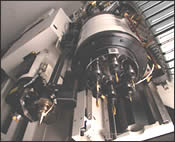
The laser cutter’s tapping unit can hold six different taps in a range of sizes, adding to the machine’s ability to process complex pipe, tube and structural components in a single setup.
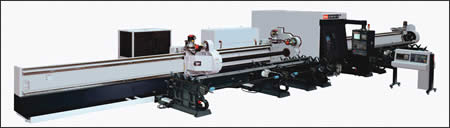
The Fabrigear series of laser cutters is designed for single-setup processing of large tubes, pipes and structural components. Each of the two models is available with either a 2,500-W or 4,000-W continuous-duty laser resonator.
Share


Multitasking machines offer a number of advantages, including reducing multiple setups that require manual material handling and refixturing. However, many fabricators still use multiple operations on separate machines to process tube and pipe components. Secondary operations such as tapping are especially problematic for large workpieces that are difficult to move and refixture. Thus, adding tapping capability to Mazak Optonics’ Fabrigear series of laser cutters is “the next logical step” for a machine that can already perform many large tube and pipe operations common in a single setup, says Bob St. Aubin, vice president of sales and marketing.
Tapping can be performed on virtually any type of tube or pipe that the Fabrigear can handle. These include not only square, round and rectangular components, but also a range of structurals, including I-beam, U-channel, C-channel and L-channel shapes. The tapping unit can hold six different taps ranging in size from No. 5 to ½ inch and metric sizes ranging from M3 to M12. The drive system uses a servo motor for tap rotation and Z-axis travel to provide “rigid” tapping characteristics, the company says. Other standard features contribute to unattended operation, including automatic tap breakage detection, an automatic tap-paste applicator and air-blast removal of dust and chips that accumulate on the tap.
Designed for large-part applications, the Fabrigear is available in two models. The FG-150 can accomomodate workpieces as long as 26 feet that weigh as much as 727 pounds, while the FG-300 can accommodate 40-foot-long materials as heavy as 1,058 pounds. To process complex 3D shapes such as I-beams, C-channels and others, the machine’s 64-bit CNC controls six axes of motion and four programmable rotary chucks. The multiple axes allow the cutting head to tilt and rotate around spinning workpieces, while the chucks are designed to grip and center tube and pipe of virtually any shape.
The chucks are part of an automatic loading/unloading system designed to limit operator involvement and simplify setup. The four chucks are divided into two sets, one on the infeed side of the machine and one on the outfeed side. Feeding arms move the workpieces from a five-position, V-support conveyor to the first set. The rear chuck grasps the tube or pipe, while the front chuck uses roller bearings to center it. The workpiece can then be handed off to the other set of chucks, either for back-end operations or for unloading via another set of V-conveyors.
Related Content
-
Finding the Right Tools for a Turning Shop
Xcelicut is a startup shop that has grown thanks to the right machines, cutting tools, grants and other resources.
-
10 Robotic Solutions You Can Find at IMTS 2026
Discover how today’s robots and cobots are making it easier than ever to automate tasks, free up skilled workers, and run machines unattended – even in small and midsized shops.
-
Briquetting Manufacturer Tools Up for Faster Turnaround Times
To cut out laborious manual processes like hand-grinding, this briquette manufacturer revamped its machining and cutting tool arsenal for faster production.


