
Manual Pallet Changers Bring Agility To The Shop
Continually searching for ways to reduce workpiece cost and to improve its responsiveness to customer demands, V-Line recently discovered how a manually operated pallet changing system could make a significant contribution to meeting its continuous improvement goals.
Share


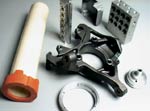
V-Line Precision Products produces a variety of workpieces in lot sizes from one to 1,000 pieces.
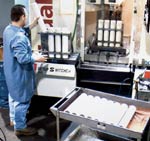
V-Line equips two of its vertical machining centers with SMW Setup-Switcher manually operated pallet changers.
V-Line Precision Products of Walled Lake, Michigan, a suburb of Detroit, is a small job shop that employs 40 people during two shifts each day. The company is in the final stages of obtaining its ISO certification, so it employs quality control methods that are approved and that meet stringent military specifications. The company also designs and builds tooling for most of its jobs in its in-house toolroom.
Continually searching for ways to reduce workpiece cost and to improve its responsiveness to customer demands, V-Line recently discovered how a manually operated pallet changing system could make a significant contribution to meeting its continuous improvement goals. The company recently applied Setup-Switcher units from SMW Systems, Inc. (Santa Fe Springs, California) to two of its vertical machining centers. The units consist of a power-operated pallet locating and clamping fixture that is mounted on the machine table, two precision cast iron pallets that are switched on and off the fixture by sidewise indexing shuttle tables, extra pallets that are stored on shelves and an adjustable-height cart that is used to transport extra pallets between the shelves and machines. The pallets are cast iron, and both pallets and clamp fixture are fitted with hardened and ground precision locators, bushings and rest surfaces. The pallets are guaranteed to repeat within 0.0002 inch.


Fred Verbridge, V-Line’s president, explains how the systems have contributed to the company’s success. “We machine a wide variety of workpieces in lot sizes that range from 1 to 1,000. Our average run is 20 pieces. On the shorter runs we changeover two to three times per shift. On these runs the pallet changers drastically reduce setup downtime because setups are made on an off-line pallet, not on the machine table, so the machine is cutting parts while the new setup is being made. Off-line setup saves us about 35 minutes. Changeovers that used to take 45 minutes now take 10 minutes. Multiply 35 minutes by four to six changeovers per day, and it adds up fast.
“On longer runs the savings derive from cleaning chips and unloading and loading parts on the off-line pallet instead of the machine table. The machine cuts parts while these tasks take place. The only downtime we have is the 1 minute required to switch the completed part and fresh part pallets. Besides making money for us at both ends of the lot-size spectrum, the Setup-Switchers have also made us more responsive to emergency and ‘overnight’ orders.”
Mr. Verbridge says that the company purchased extra pallets so it could mount repeat order pre-aligned fixtures on them and store them on shelves. “When a rush order comes in, we can have it under the spindle in less than 30 minutes. On short runs we can deliver in 24 hours, and our customers love us.”
Another advantage pallet changers offer is the ability to nearly eliminate downtime while inspecting the first part of a new run. Once the new job is set up on a pallet away from the machine, it is transported to the machine. The current job being run is interrupted, and its pallet is switched with the new one. Next, machining programs are switched and the first new part is machined. The pallets and programs are then switched back, so machining continues while the new part is being inspected. Many shops inspect the new part while it is still on the pallet, which saves inspection time.
Similar to most shops, V-Line has found it difficult to find and hire skilled machinists. However, with advantages gained by employing pallet changers, the company is able to run its entire second shift with only one skilled setup person. It discovered that these accessories can often double machine output; double the output of the skilled personnel involved; and save the costs associated with a second machine, an operator, tooling and floor space. The impact these economies have on a company’s bottom line is the force behind the growing popularity of pallet changers in shops that will continue to “survive the cut.”


Related Content

10 Robotic Solutions You Can Find at IMTS 2026
Discover how today’s robots and cobots are making it easier than ever to automate tasks, free up skilled workers, and run machines unattended – even in small and midsized shops.
Read More
Workholding Fixtures Save Over 4,500 Hours of Labor Annually
All World Machinery Supply designs each fixture to minimize the number of operations, resulting in reduced handling and idle spindle time.
Read More
Finding the Right Tools for a Turning Shop
Xcelicut is a startup shop that has grown thanks to the right machines, cutting tools, grants and other resources.
Read More
Shop Reclaims 10,000 Square Feet with Inventory Management System
Intech Athens’ inventory management system, which includes vertical lift modules from Kardex Remstar and tool management software from ZOLLER, has saved the company time, space and money.
Read MoreRead Next

OEM Tour Video: Lean Manufacturing for Measurement and Metrology
How can a facility that requires manual work for some long-standing parts be made more efficient? Join us as we look inside The L. S. Starrett Company’s headquarters in Athol, Massachusetts, and see how this long-established OEM is updating its processes.
Read More