The Case for Off-Site Innovation
Okuma says the point of its aerospace technology center is to provide a place for manufacturers to perform all the trial-and-error they need to perfect a new process. It’s also a place to find and consult with sources of up-to-date manufacturing technology expertise.

Share


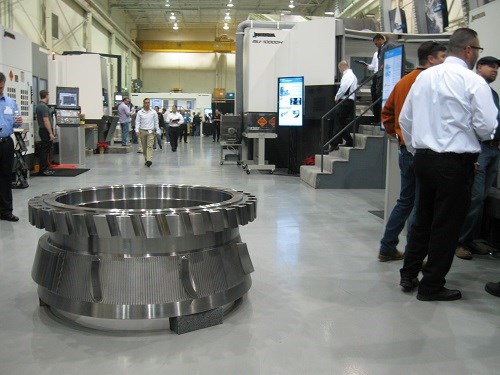
Okuma wants to help its customers succeed. Part of that is helping them fail.
According to Wade Anderson, the company’s manager of technology centers, providing customers with “a place to fail” is a large part of the reason why the machine tool builder this year opened a new technology center devoted to aerospace machining. The company’s initial development partners in this new aerospace-focused facility include Sandvik Coromant and 5ME.


The 10,000-square-foot space at Okuma’s Charlotte, North Carolina, U.S. headquarters includes a range of machine tool types the makers of critical aircraft components are likely to employ, including large-travel five-axis machining centers and Y-axis live-tool lathes. For a manufacturer to commit its own in-house resources to developing and proving out a new machining process is often impractical, Mr. Anderson says, because no one can say how long the trial-and-error will take. This is particularly true in aerospace machining, which often involves materials that are difficult to cut and geometries that are difficult to achieve.
In fact, Mr. Anderson says it’s increasingly likely that the expertise for process innovation might not be available within a manufacturer’s own facility, either. The very nature of expertise has changed, he says. We see this at the level of our individual work and interests, where we no longer master information to the extent that someone might have done a generation ago, but instead we rely on online searches for the information we need as the need arises. Something similar is true at the level of manufacturing process innovation, he says. Technologies are advancing rapidly enough and interrelating to such an extent that, for a production manufacturer, trying to develop and maintain up-to-date manufacturing expertise might be a hopeless struggle. Better to rely on resources able to provide current knowledge as needed.
One of the center’s partners exemplifies this. 5ME is a manufacturing technology firm offering various tooling and shopfloor management technologies, as well as (perhaps most significantly) cryogenic machining. This is a technology still unknown or little known to many manufacturers, though it has the potential to benefit various processes involving machining aerospace alloys.
Meanwhile, Mr. Anderson observes that tooling technology has advanced to the point that previously accepted expectations about productive machining parameters are now in some cases far off-base. And machine tool capabilities have advanced to the point that even basic decisions such as whether a machining center or a turning machine is the right choice for a part might deserve to be reevaluated. Getting outside of the organization to encounter people thinking about these topics is valuable, particularly experts from different technology suppliers knowledgeable about different facets of these questions.
He says the aerospace center is a logical step forward for Okuma’s “Partners in THINC,” the affiliation of companies all offering technology complementary with Okuma’s THINC control. With 50 companies now part of Partners in THINC, the range of potential technology solutions is vast but potentially daunting. In the aerospace center, by contrast, engaging partners on a project-by-project basis is part of maintaining the sole-industry focus of the center. If this works well, he believes it is likely that other industry-focused centers will follow.
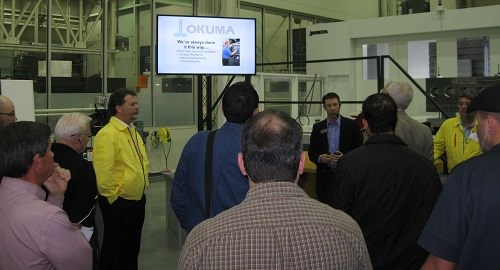
Photos of the new aerospace tech center were taken at a recent open house, where Wade Anderson (seen here) was one of the presenters.


Related Content

How Precision Blanks Help This Aerospace Shop Build Better Parts
Internal stress in thin metal parts can lead to warped components and scrapped work. Matrix Machine found a better way by sourcing precision-ground blanks from TCI Precision Metals. Here’s how that decision freed up capacity and made critical parts more predictable.
Read More
Gear Surface Texture Is More Important Than Ever
The interactions of gear surfaces are becoming increasingly important in applications such as automotive electric motor drive systems and aircraft turbines.
Read More
Greenleaf End Mills Optimize Machining Stability
Capstone-360 end mills are well suited for machining HRSAs, cast iron and hardened steel materials for the aerospace, oil and gas, power generation and medical industries.
Read More
Rigidity and Reliability More Than Double Aerospace Shop’s Revenue
By adopting a six-axis mill with a tripodal head and a pallet system, Omni Aerospace has cut its cycle and setup times for large parts, massively increasing its revenue.
Read MoreRead Next

OEM Tour Video: Lean Manufacturing for Measurement and Metrology
How can a facility that requires manual work for some long-standing parts be made more efficient? Join us as we look inside The L. S. Starrett Company’s headquarters in Athol, Massachusetts, and see how this long-established OEM is updating its processes.
Read More