Kitamura
Published

Turning to an Alternative for Small, Complex Work

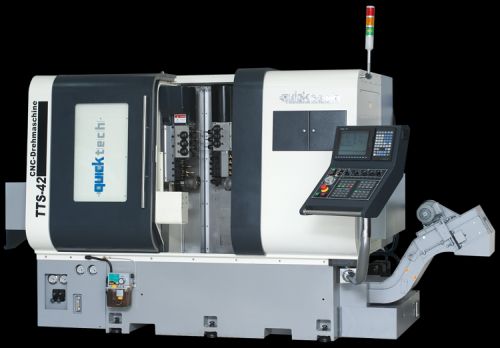
The QuickTech TT-42 from Absolute Machine Tools provides many of the same advantages as a Swiss-type lathe for small, complex parts that don’t justify the use of a guide bushing.

Share

Leaders-In background
Loading the player ...

As shown in this video, the TT-42's configuration enables users to maneuver cutting tools very close to the work, which helps avoid rigidity issues with small parts. The machine also provides the multi-function capability to machine parts complete in one setup, even to the extent of cutting two complex components simultaneously on either spindle.


When Mark Schubert first laid eyes on the QuickTech TT-42 turning center he’d soon be selling for Absolute Machine Tools (Lorain, Ohio), the first potential customers that came to mind were users of Swiss-type lathes. That might seem odd, considering the Swiss-type has proven itself as a go-to platform for producing small, complex parts in one setup—the same role envisioned for the TT-42. However, Mr. Schubert contends that rather than stepping on Swiss-types’ toes, this dual-spindle, 8-axis turn-mill fills an important, complementary niche: parts that don’t require a guide bushing, yet aren’t suitable for production on smaller turn-mills.
 
The guide bushing is the defining feature of a Swiss-type. By supporting the barstock very near the point of the cut, it provides the rigidity required to precisely machine long, slender parts without deflection or vibration. In the field, however, these machines tend to be valued equally as much for their versatility, says Mr. Schubert, who sells Swiss-types from Star (Roslyn Heights, New York) in addition to serving as a regional vice president of sales for Absolute. He notes that many customers use their Swiss-types’ subspindles and live tools for fast, single-setup machining regardless of whether the part is long enough to benefit from a guide bushing.
 
However, this strategy comes at a cost, Mr. Schubert explains. First, Swiss-types tend to require a larger up-front investment than conventional fixed-headstock turning centers. Second, barstock must meet certain straightness and diameter tolerances to fit within the guide bushing. With typical clearances of only 0.001 inch between the stock and the bushing, using anything other than costly, centerless-ground bar can result in out-of-round conditions, poor surface finish and other problems.
 
That being the case, a small, conventional turn-mill might seem to be a more cost-effective choice for parts with length-to-diameter ratios that don’t justify the use of a guide bushing. After all, many fixed-headstock turning centers with subspindles and Y-axes offer all the multi-function versatility of a Swiss-type. However, the slant-bed construction that is typical of such machines can cause clearance issues with smaller workpieces and cutting tools, Mr. Schubert says.  
 
To approach the work at the proper angle, these machines’ tool turrets or spindles must be mounted to the slanted bed with a cross-slide or other apparatus. This introduces extra mass that, in addition to the bulk of the turret or spindle itself, can interfere with the close-quarters machining required for small, complex parts.“On a slant-bed with a turret, getting, say, a 1/8-inch-diameter end mill close to a small part may cause interference between the tool and the chuck,” Mr. Schubert says. “You’d have to extend the tool itself or extend the part further out from the chuck to maintain clearance, but that can create problems with rigidity.”
 
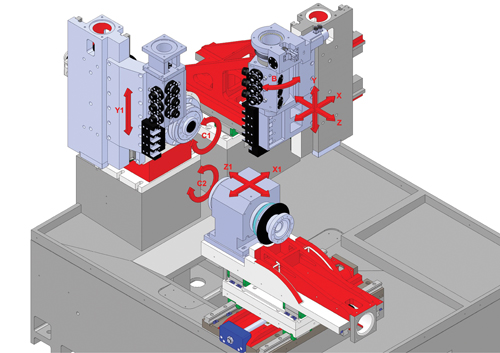
In contrast, the TT-42 employs a flat-bed design with dual, live-tool gang slides on a vertical plane that move the X, Y and Z axes, just like those on a typical Swiss-type. Complete with a subspindle and backworking tool posts, this configuration enables users to maneuver cutters close to the stock for rigid, multi-operation machining of small parts without clearance issues or the need for a guide bushing, Mr. Schubert says. He adds that eliminating the additional bulk associated with Y-axis-equipped slant-bed designs improves operator access to the workzone. In fact, he estimates this configuration reduces the distance between the door and the spindle centerline by approximately 20 percent compared to a similarly sized slant-bed machine.
 
Various options are available to enable the TT-42 to take on a wider range of work. For example, electric spindles from Ibag (North Haven, Connecticut) can provide speeds ranging to 60,000 rpm, as opposed to the standard 6,000 rpm. Likewise, a B-axis option enables the gang tool slides to swivel ±45 degrees for contouring or angled drilling operations.
 
Still, Mr. Schubert emphasizes that the machine’s role is application-specific. Misapplying it entirely is just as likely as overlooking its capabilities. “By no means does the TT-42 do Swiss turning,” he explains. “Parts of a certain length-to-diameter ratio are always better suited for a Swiss-type. Nor does it have the horsepower for heavy milling work, like a conventional turn-mill might. This machine is a hybrid.”


Kitamura
YCM Alliance
paperlessPARTS
IMTS 2026
Dimensional Air Gage Specialists
DN Solutions
EMUGE FRANKEN
Gravotech

Related Content

Sponsored

The Future of High Feed Milling in Modern Manufacturing

Achieve higher metal removal rates and enhanced predictability with ISCAR’s advanced high-feed milling tools — optimized for today’s competitive global market.

Read More
Sponsored

Addressing Manufacturing Challenges with Automation

GrayMatter Robotics’ Physical AI robotic cells for manufacturing offer immediate impact and results.  

Read More

Controlling Extreme Cutting Conditions in Large-Part Machining

Newly patented technologies for controlling chatter and vibration during milling, turning and boring operations promise to drastically reduce production time and increase machining performance.

Read More

4 Tips for Staying Profitable in the Face of Change

After more than 40 years in business, this shop has learned how to adapt to stay profitable.

Read More

Read Next

Measurement

OEM Tour Video: Lean Manufacturing for Measurement and Metrology

How can a facility that requires manual work for some long-standing parts be made more efficient? Join us as we look inside The L. S. Starrett Company’s headquarters in Athol, Massachusetts, and see how this long-established OEM is updating its processes.

Read More
Kitamura