Nidec Double-Column Machining Center Reduces Non-Cutting Time
Powered by electricity, MV12BxII is designed for a diverse range of production environments, from high-precision surface machining to general parts machining

Share


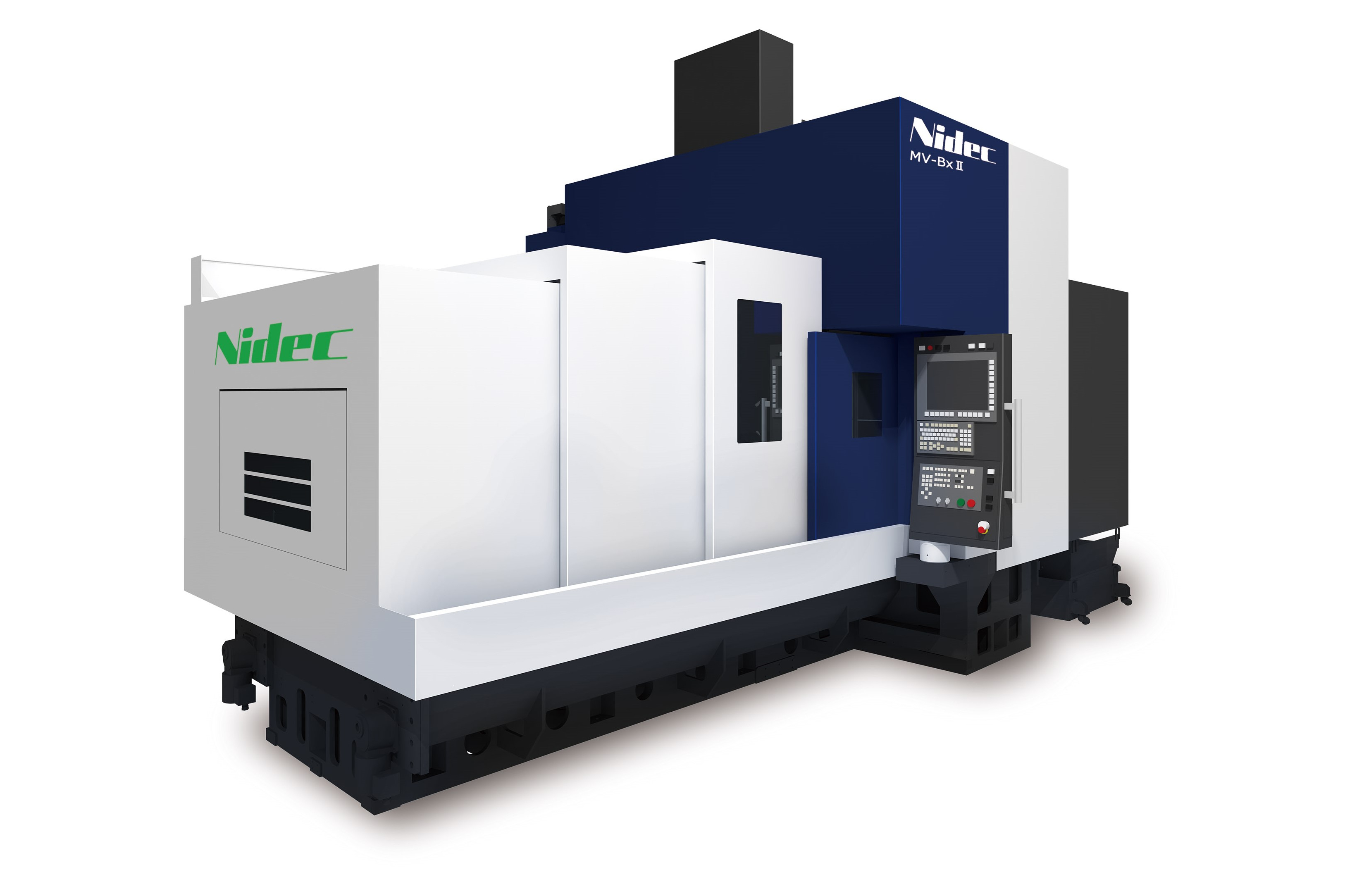
Nidec Machine Tool Co.’s double-column machining center, MV12BxII, is designed to reduce non-cutting time while achieving high productivity in a range of applications. MV12BxII uses grease to lubricate all of its spindle and feed axes to improve energy efficiency and running cost. Featuring an electric power unit, the machine is designed for a diverse range of production environments, from high-precision surface machining to general parts machining, including light cutting and heavy cutting.
With the high-speed rapid traverse (X-axis: 48 m/min.; Y- and Z-axes: 32 m/min.), MV12BxII provides shorter non-cutting time, while its spindle’s maximum rotating speed has been improved to 7,000 min-1, and its motor output has been increased to 26 kW. It features a compact footprint of 3.4 × 5.8 m and a maximized range of operation (X-axis stroke: 1.6 m; Y-axis stroke: 1.3 m).
With the use of an energy-efficient and low-noise electric power unit to operate its pump only when necessary, MV12BxII consumes less power than conventional hydraulic units that are always running. In addition, the adoption of Nidec’s tribology technology enables the use of grease to lubricate MV12BxII’s spindle and feeding axes, helping the machine to use less air and lubricant agent, reducing running cost and operator workload.
Additionally, MV12BxII has available a variety of options that were jointly developed with Nidec OKK Corporation, including an automatic operator door, a coolant shower and a selectable chip conveyor.
Related Content
-
A History of Precision: The Invention and Evolution of Swiss-Style Machining
In the late 1800s, a new technology — Swiss-type machines — emerged to serve Switzerland’s growing watchmaking industry. Today, Swiss-machined parts are ubiquitous, and there’s a good reason for that: No other machining technology can produce tiny, complex components more efficiently or at higher quality.
-
How to Successfully Adopt Five-Axis Machining
While there are many changes to adopt when moving to five-axis, they all compliment the overall goal of better parts through less operations.
-
Ballbar Testing Benefits Low-Volume Manufacturing
Thanks to ballbar testing with a Renishaw QC20-W, the Autodesk Technology Centers now have more confidence in their machine tools.


