Can Transparency Bring More Efficient Sourcing?
A resource that aims to be free for machine shops asks detailed capability information so parts can be matched to producers, and OEMs can target RFQs to shops that are ready to run the work.

Share


It is not hard for an OEM in need of machined parts with specific requirements to find a machine shop able to meet the need. The problem lies in also finding so many other shops at the same time that are not quite suited to the work. How does the buyer identify which of the shops that seem promising is actually a good fit?
And it is not hard for that same buyer seeking machining work to find shops with open capacity, even open capacity for particular machine types and travels. The problem is that capacity is not a commodity. Different shops use their capacities in different ways.


All of this is as much a problem for machine shops as it is for buyers of machining services. The overabundance of RFQs that shops contend with and sort through is in part a result of the lack of transparency, and the lack of knowledge, between manufacturing buyers and providers. Ironically, shops would be aided by a platform that would accurately characterize and filter them, and therefore in many cases accurately exclude them from consideration.
A group of supply-chain professionals formerly with SpaceX is now working to develop exactly this platform. Their company is Datum, and the platform they aim to commercialize is based on “radical transparency” into supplier capabilities, says CEO Robert Pakalski. I recently spoke with him about the company, its aims and what role it might play in buyer/supplier relationships of the future.
Significantly, he says only half of Datum is supply-chain experts. The startup’s staff of 10 at the moment I spoke with him included five from the supply-chain world and five with software expertise. The problems supply-chain leaders encounter are in some cases solvable using data the part file contains, he notes, if only the data can be effectively leveraged. The logic-based sourcing platform Datum is building interrogates CAD files in order to identify relevant machine types and machine travels, and in this way identify suppliers.
“Machine shops are not apples to apples,” Pakalski says. To be sure, they differ in far more than their machine types and capacities, but even these differences are opaque to OEMs, who themselves might be sourcing parts through purchasing professionals who don’t necessarily discern the different machining needs of different parts. Examples of the kinds of routine mismatches that result include RFQs for five-axis jobs being sent to three-axis shops, and large parts left hanging off the machine bed because the job was won by a shop with not quite the right work envelope size. And this says nothing of the complex part that cannot be machined efficiently by a given shop because it lacks a multitasking turning machine with the right Y-axis travel.
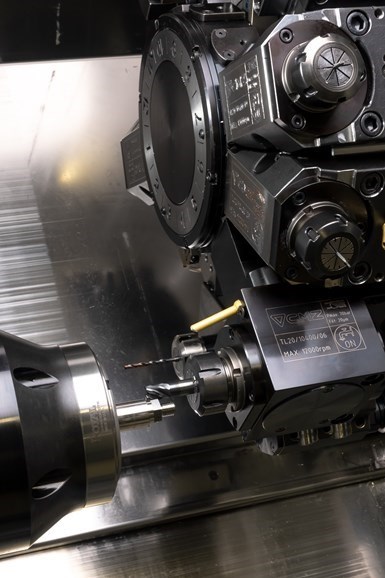
The work envelope of multitasking machines is an example of a capability metric useful for prequalifying shops. (This photo from Prosper-Tech Machine & Tool, which we wrote about here.)
On a multitasking machine, Pakalski notes there are fundamental characteristics important to qualify a given supplier to run a job. They include machine envelope in diameter and length; the various axes useful to the part and their travels; and the orientation of the spindle. From there, other machine parameters might prove valuable as additional qualification constraints. Meanwhile, other machine tool types have their own sets of important parameters. In characterizing machines, he says the team has focused on specifications apt to be germane to successfully machining parts needed by the space sector (the founders’ home field). Ultimately, interrogating the CAD file will allow for automatically identifying the machining process and the specific machine tool specs the part needs, including optional spec requirements added by the user, and Datum’s system will then be able to layer other considerations into the qualification such as a shop’s quality capabilities and its proximity to buyer.
It is a difficult analysis for software to perform automatically, but that is the aim. “We will start with space because we want to be able to nail one industry,” he says. The team will proceed industry by industry from there, and also proceed into other processes beyond CNC machining.
A test of 100 representative machined parts for the space sector so far shows Datum’s platform delivering 80% success at matching parts to correct shops. Further refinement can raise this to near 100%, the CEO says. When I spoke to him, there were 60 machining suppliers Datum had gathered into the platform that could be discovered there. He expects the number to be 100 by the time you read this, and more by the time this capability is tested as a sourcing resource by early OEM users.
Machine shops brought into the platform provide needed data about their machines and capabilities. They will also be able to freely flag and unflag their status as accepting work. Shops’ inclusion will be free of charge, Pakalski says, because Datum expects to profit by selling access to the manufacturing buyers, who need the assist in filtering and identifying suppliers. Once the buyer finds a promising supplier through the system, the buyer will communicate and contract with the shop directly.
“We won’t be a broker — we don’t want that role,” he says. Value will instead come from saving time for manufacturing buyers and delivering better manufacturing by more cleanly and accurately connecting parts to producers. OEMs will pay to employ the system, and to realize this value. For this reason, the Datum team expects shops will want to join and be discoverable there. In other words, Pakalski expects shops will want to be part of a network that is discerning and sensitive enough to sometimes rule them out.


Related Content

Shop Tour Video: Inside an Aviation & Defense Machine Shop
Grants. Software. Process consolidation. These three pillars can bring new life to a shop, enabling it to take on more complex jobs with faster turnarounds. In this shop tour, find out how MSP Manufacturing has used each pillar to solidify itself as a reliable partner for defense and aerospace companies.
Read More
Taiwan Machine Tool Industry Showcases AI Innovations at EMO 2025
The Taiwan External Trade Development Council highlighted AI-powered solutions for precision and sustainability in manufacturing.
Read More
How Precision Blanks Help This Aerospace Shop Build Better Parts
Internal stress in thin metal parts can lead to warped components and scrapped work. Matrix Machine found a better way by sourcing precision-ground blanks from TCI Precision Metals. Here’s how that decision freed up capacity and made critical parts more predictable.
Read More
LK Metrology Surface Roughness Probe Enhances Component Inspection
LK Metrology’s Surfacers SRP high-resolution probe is designed for seamless surface analysis within CNC measuring cycles on CMMs.
Read MoreRead Next

OEM Tour Video: Lean Manufacturing for Measurement and Metrology
How can a facility that requires manual work for some long-standing parts be made more efficient? Join us as we look inside The L. S. Starrett Company’s headquarters in Athol, Massachusetts, and see how this long-established OEM is updating its processes.
Read More