
Submerged in Robotics
The new Denso IP67 submersible robot doesn’t mind a shower of metalworking coolant, which makes it ideal for tending CNC machines inside their enclosures. This capability was demoed during the company’s 50 years of robotics celebration its newest training center in West Chester, Ohio.

Share


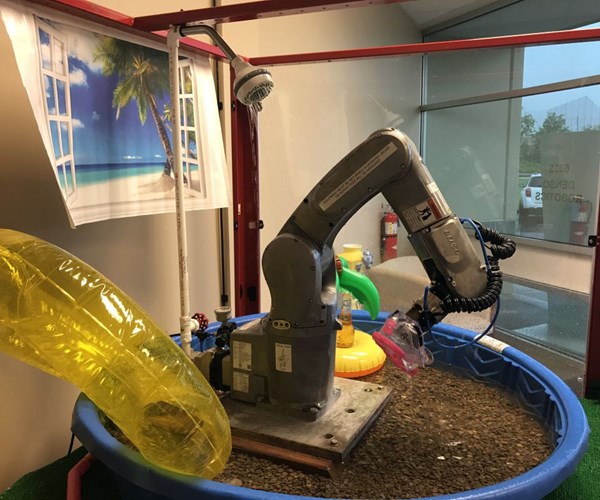
The Denso IP67 submersible robot doesn’t need to wear goggles, but this accessory adds to the demo’s visual appeal.
Denso’s first robot was a three-axis pick-and-place device developed in 1967, says Robotic Sales Department Manager Peter Cavallo. Since then, he says the company’s Denso Robotics group has begotten nine generations of robots. Some of the newest examples of Denso robotics technology, including a waterproof, submersible model, were on display at the company’s Robotics Sales, Application and Training Center in West Chester, Ohio, a northern suburb of Cincinnati about halfway to Dayton on Interstate 75.
A recent open house at this facility also celebrated the company’s half-century milestone as a developer of robotic technology. In marking this achievement, Mr. Cavallo explained that Denso Corp., headquartered in Kariya, Japan, is one of the world’s largest automotive parts manufacturers, becoming a long-time pioneer and technology leader in the design and manufacture of small industrial robots, especially for assembly. These robots and related technology are globally available through the firm’s Denso Robotics unit. However, Mr. Cavallo noted that Denso is the world’s largest user of its own robot products, with more than 18,000 units installed in the company’s manufacturing facilities around the world.


“That’s exactly why these robots are built the way they are. To succeed in the highly competitive automotive sector, Denso requires its robots to deliver not only extremely high levels of productivity, but also the lowest cost of ownership,” Mr. Cavallo explains. “The company looks for low maintenance, ease of integration, ease of setup and programming, low energy consumption, high reliability and long working life—the same values buyers in other companies are looking for,” he says.
Spotlight on Technology
Although high-speed, precise assembly is the main focus of robotic applications for Denso robots, they are used in a variety of applications. One of the displays at the West Chester facility made this point in an unusual fashion. The new Denso IP67 submersible robot doesn’t mind a shower of metalworking coolant, so it can tend CNC machines inside their enclosures. An imaginative demo of this waterproof capability showed the robot operating under a showerhead on a simulated beach scene complete with beach toys and palm tree. The demo also showed how the robot could manipulate a simulated parts washer nozzle from inside the machine.
Other technology highlights at the event included the RC8A robot controller that adds a Safety Motion feature, which enables creation of virtual fences around the robot. Safety Motion uses two optical sensors, one at the top and one at the bottom of the cell, to detect an approaching operator and control the speed of the robot accordingly. The sensors create virtual safe zones that trigger an incremental reduction in the speed of the robot to safe levels depending on the distance of the operator, the company says. When the operator reaches the closest zone, the robot reduces its motor torque and slows down sufficiently to allow the operator to safely interact with it, or stops entirely. As soon as the operator leaves, the robot automatically resumes running at normal speed, minimizing stoppage time.
Spotlight on the Training Center
The company’s newest training center, located in West Chester, provides training and support for customers in the Midwest, East Coast and Southern regions of the country. It operates in conjunction with two similar centers in Long Beach, California, and Maryville, Tennessee. It provides customer support services for end-users, approved distributors and system integrators. Training covers basic and advanced robot programming, operation, maintenance and the open-source ORiN programming language, the company says. Students have access to robot controllers, vision hardware, wireless infrastructure and workstations, along with dedicated, hands-on robots.


Related Content

Cutting Part Programming Times Through AI
CAM Assist cuts repetition from part programming — early users say it cuts tribal knowledge and could be a useful tool for training new programmers.
Read More
Embracing Automation: Strategies for Small to Medium-Sized Machine Shops
Business drivers for automating to help navigate workforce challenges and boost profitability.
Read More
Aerospace Shop Thrives with Five-Axis, AI and a New ERP
Within three years, MSP Manufacturing has grown from only having three-axis mills to being five-axis capable with cobots, AI-powered programming and an overhauled ERP. What kind of benefits do these capabilities bring? Find out in our coverage of MSP Manufacturing.
Read More
Setting Up the Building Blocks for a Digital Factory
Woodward Inc. spent over a year developing an API to connect machines to its digital factory. Caron Engineering’s MiConnect has cut most of this process while also granting the shop greater access to machine information.
Read MoreRead Next

OEM Tour Video: Lean Manufacturing for Measurement and Metrology
How can a facility that requires manual work for some long-standing parts be made more efficient? Join us as we look inside The L. S. Starrett Company’s headquarters in Athol, Massachusetts, and see how this long-established OEM is updating its processes.
Read More