
ABB Expands Easy-Setup Cobot Portfolio with GoFa and Swifti
ABB Inc. has added the GoFa and Swifti cobots to its portfolio, offering easy-to-program automation for increased operational safety and efficiency.

Share


Phillips Corporation - Education
Featured Content
View More


Phillips Corporation
Featured Content
View More


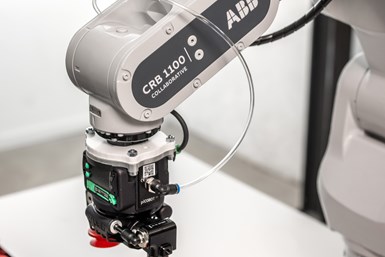
ABB Inc.’s collaborative robot (cobot) portfolio expands with the GoFa and Swifti cobot families, which join its YuMi and Single Arm YuMi. ABB says these swift and versatile cobots will accelerate the company’s expansion in high-growth segments including electronics, healthcare, consumer goods, logistics and food and beverage.
Users can operate GoFa and Swifti with ABB’s tablet- and smartphone-compatible setup tools, meaning customers will not need in-house programming specialists. ABB believes this simplicity will appeal to industries that have not invested in older, more complicated automation options — GoFa and Swifti customers can operate their cobot within minutes of installation, straight out of the box, with no specialized training.


“Our new cobot portfolio is the most diverse on the market, offering the potential to transform workplaces and help our customers achieve new levels of operational performance and growth,” says Sami Atiya, president of ABB’s Robotics and Discrete Automation business area.
ABB recommends using GoFa and Swifti to automate processes such as material handling, machine tending, component assembly and packaging in manufacturing, medical laboratories, logistics hubs and warehouses, workshops and small production facilities.
“With this expansion, we are making cobots easier to use and deploy, with real-time support to help speed their adoption in businesses that may not have previously considered their use,” Atiya says. “Our experience is that the best performing operations harness people’s skills, alongside the potential of new technologies.”
ABB’s cobot installations include a start-up package with ABB Ability condition monitoring and diagnostics, as well as free access to ABB’s technical assistance support hotline for six months.
Related Content
-
Robotic Cells Transform Archery Bow Manufacturing Efficiency
Mathews Archery boosted bow riser production by 25% through robotic automation with CNC Solutions. Overcoming labor shortages, the system enables unattended weekend runs, halves scrap, and delivers 1.5-year ROI.
-
Setting Up the Building Blocks for a Digital Factory
Woodward Inc. spent over a year developing an API to connect machines to its digital factory. Caron Engineering’s MiConnect has cut most of this process while also granting the shop greater access to machine information.
-
Studer's Automation, Entry-Level Solutions Take Center Stage
At its 2024 Music Motion Meeting, Studer AG showed off its entry-level line of grinding machines, as well as its newest universal loading system.

